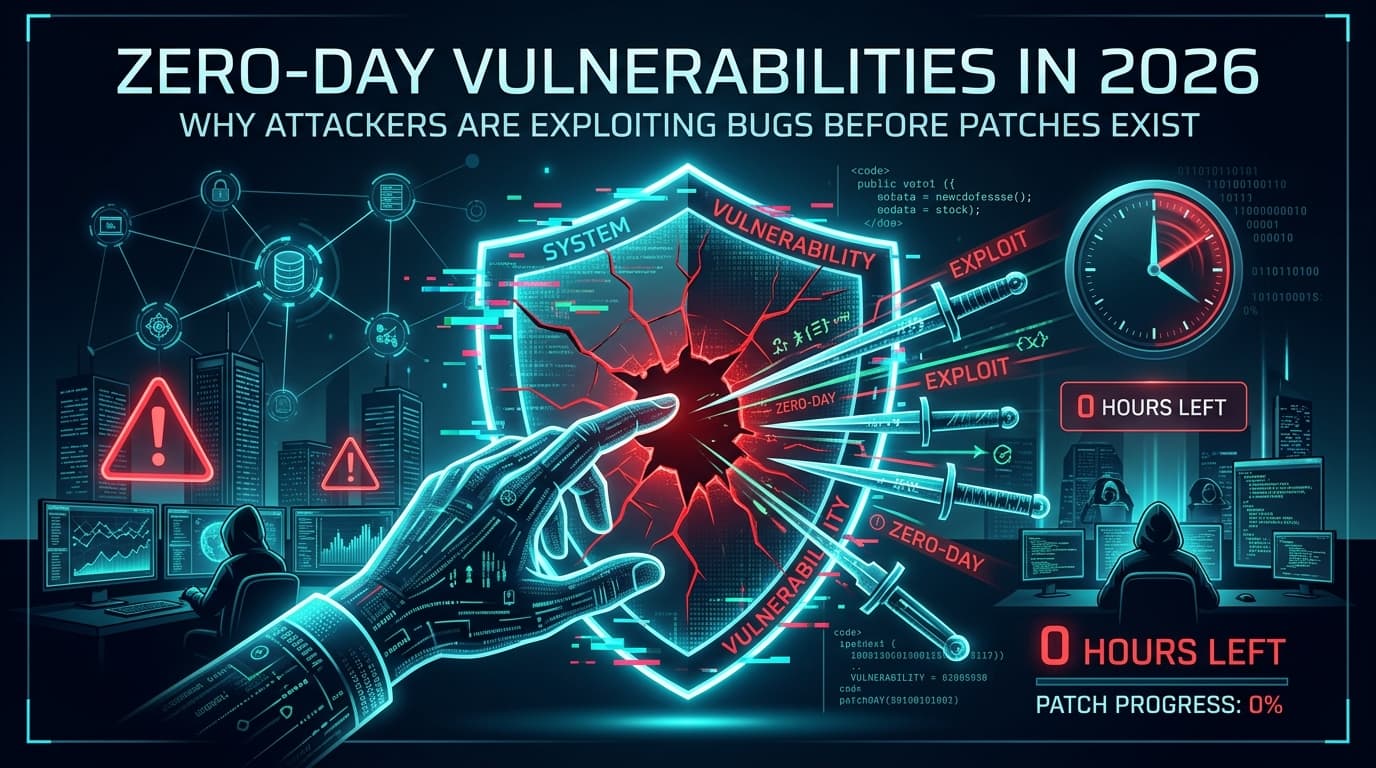
Adaptive Cybersecurity: The self-evolving defense
The attacker only needs to be right once. The defender needs to be right every time. Adaptive cybersecurity is the first serious answer to that asymmetry.
2026-03-28
 ZextOverse
Loading articles...
The attacker only needs to be right once. The defender needs to be right every time. Adaptive cybersecurity is the first serious answer to that asymmetry.
For most of computing history, cybersecurity has been a fundamentally reactive discipline.
An attacker finds a novel technique. Security researchers observe it in the wild. A signature is written. A patch is issued. A rule is added to the firewall. The defender updates their defenses — and waits for the next novel technique.
This cycle has a name in the industry: detect and respond. And for decades, it more or less worked. Attackers were relatively few, their tools were expensive to develop, and the gap between a new attack and a viable defense was measured in weeks.
That world is gone.
Today, threat actors operate at machine speed. Ransomware groups run like software companies, complete with HR departments, customer service portals, and affiliate programs. Nation-state actors have nearly unlimited development budgets. AI-assisted attack generation means that novel malware variants can be synthesized in seconds, defeating signature-based detection before a human analyst even sees the alert.
The old perimeter is dead. The castle-and-moat model — strong walls, everything inside is trusted — collapsed under the weight of cloud infrastructure, remote work, and supply chain complexity.
Adaptive cybersecurity is the emerging response: defense systems that don't wait to be told what an attack looks like, but continuously learn, evolve, and reconfigure themselves in response to the threat landscape.
The word adaptive is overused in security marketing. Every vendor claims their product "adapts." It's worth being precise about what genuine adaptive security entails.
A truly adaptive system exhibits four core properties:
The system maintains persistent, comprehensive visibility into its environment — not just network traffic at the perimeter, but endpoint behavior, user activity patterns, cloud configuration states, identity flows, and third-party integrations. This telemetry is collected continuously, not sampled periodically.
Rather than matching traffic against a static list of known-bad signatures, adaptive systems build dynamic behavioral baselines — statistical models of what "normal" looks like for every user, device, service, and data flow in the environment. Anomalies are detected relative to that baseline, not against a fixed ruleset.
When a threat is detected, adaptive systems don't just alert — they act. Isolating a compromised endpoint, revoking an anomalous session token, blocking a suspicious API call, or quarantining a lateral movement attempt — all without waiting for a human to approve each step.
Every detection event — true positive, false positive, or missed attack — feeds back into the system's models. The system learns from its own mistakes and updates its behavior accordingly. Yesterday's tuning is today's baseline; tomorrow's baseline reflects what happened overnight.
This is the crucial distinction between adaptive security and automated security. Automation executes predetermined rules faster. Adaptation changes the rules themselves.
Modern adaptive security systems are rarely monolithic. They're ecosystems of interconnected components, each contributing to a continuous sensing-thinking-acting loop.
┌─────────────────────────────────────────────────────────┐
│                     OBSERVE                             │
│  Endpoints · Network · Identity · Cloud · Third-Party   │
└────────────────────────┬────────────────────────────────┘
                         │  Raw telemetry (billions of events/day)
                         ▼
┌─────────────────────────────────────────────────────────┐
│                    CORRELATE                            │
│  SIEM · Data Lake · Graph Analytics · Threat Intel      │
└────────────────────────┬────────────────────────────────┘
                         │  Enriched, contextualized signals
                         ▼
┌─────────────────────────────────────────────────────────┐
│                     ANALYZE                             │
│  ML Models · Behavioral AI · Anomaly Detection          │
│  LLM-Assisted Reasoning · Kill Chain Correlation        │
└────────────────────────┬────────────────────────────────┘
                         │  Prioritized, explainable detections
                         ▼
┌─────────────────────────────────────────────────────────┐
│                      RESPOND                            │
│  SOAR Playbooks · Autonomous Containment                │
│  Human-in-the-Loop Escalation · Deception Tech         │
└────────────────────────┬────────────────────────────────┘
                         │  Actions + outcomes
                         ▼
┌─────────────────────────────────────────────────────────┐
│                      EVOLVE                             │
│  Model Retraining · Playbook Optimization               │
│  Threat Intel Sharing · Red Team Feedback               │
└─────────────────────────────────────────────────────────┘
Each layer feeds the next, and the bottom feeds back to the top — a closed loop that tightens over time.
The intelligence in adaptive cybersecurity is built on several complementary machine learning paradigms, each suited to different aspects of the threat detection problem.
Supervised models are trained on labeled datasets — millions of examples of known malware, phishing emails, or malicious network packets, alongside benign counterexamples. These models excel at classifying known threat categories and generalize reasonably well to variants of known attacks.
Their weakness is fundamental: they can only recognize what they've been shown. A zero-day exploit with no prior examples will likely pass through a purely supervised model undetected.
Unsupervised models — particularly autoencoders, clustering algorithms, and isolation forests — don't need labeled examples of attacks. Instead, they learn the structure of normal behavior and flag deviations.
An autoencoder trained on normal DNS query patterns, for example, will assign high reconstruction error to DNS queries that are being used for command-and-control tunneling — even if it has never seen that specific technique before. The anomaly is detected not because it matches a known attack, but because it doesn't match normal.
This is the foundation of true zero-day detection.
Modern attacks rarely involve a single event. They unfold across time, devices, accounts, and services — a reconnaissance scan here, a credential theft there, a lateral movement event three hours later. Individual events may each look benign in isolation.
Graph Neural Networks (GNNs) model the environment as a dynamic knowledge graph — entities (users, devices, processes, files) as nodes, and their interactions as edges. By analyzing the evolving graph structure, GNNs can surface attack chains that point-in-time detection misses entirely.
This is particularly effective against Advanced Persistent Threats (APTs), which are designed explicitly to be slow, quiet, and spread across many apparently unrelated events.
The most recent addition to the adaptive security toolkit is the application of LLMs to threat analysis. LLMs can:
Platforms like Microsoft Security Copilot and Google's Chronicle AI have begun integrating LLMs into security operations workflows, effectively giving analysts an AI reasoning partner that can process and synthesize vast amounts of context faster than any human team.
One of the more elegant components of adaptive defense is deception technology — a category that includes honeypots, honeytokens, and full-scale deception fabrics.
The core idea inverts the traditional dynamic. Rather than only defending real assets, adaptive systems lace the environment with fake ones: decoy credentials in Active Directory, canary tokens embedded in sensitive documents, honeypot servers that appear to contain valuable data.
An attacker who touches a honeytoken has, by definition, done something no legitimate user ever does. The detection is zero false positives — there's no such thing as a legitimate access of a credential that doesn't exist.
What makes modern deception technology adaptive is that the decoys themselves evolve. Systems analyze which assets attackers are targeting in the real environment and generate convincing fakes that mirror those assets. If attackers are hunting for database credentials, the deception layer plants plausible-looking database credentials in likely discovery locations.
The honeypots don't just detect — they study. Attackers who interact with deception infrastructure reveal their tools, techniques, and objectives, feeding that intelligence back into the defensive models.
Zero Trust Architecture (ZTA) is often described as a security philosophy, but at its core it's an adaptive systems design principle: never trust, always verify, continuously evaluate.
In a Zero Trust model:
The "adaptive" dimension of Zero Trust is the continuous re-evaluation. A user who authenticates normally at 9 AM but then begins downloading unusual volumes of sensitive data at 11 AM sees their access rights dynamically adjusted — perhaps stepped-up authentication is required, or access to certain resources is temporarily suspended — without any human intervention.
NIST's Special Publication 800-207 formalizes the Zero Trust architecture, and it has become foundational to US federal cybersecurity policy following Executive Order 14028.
Fully autonomous security response sounds appealing until you consider the consequences of being wrong. An adaptive system that autonomously isolates a host from the network could, if miscalibrated, take down a hospital's medical imaging system or interrupt a financial institution's transaction processing.
The practical answer is tiered autonomy — a model where the system's authority to act autonomously scales with its confidence and the reversibility of the action:
| Confidence Level | Action Type | Autonomy |
|---|---|---|
| High | Reversible (block IP, revoke token) | Fully autonomous |
| High | Irreversible (delete file, terminate process) | Autonomous + logged |
| Medium | Any | Automated + analyst notification |
| Low | Any | Alert only, analyst decides |
| Any | Business-critical systems | Human approval required |
Human analysts in adaptive security operations are increasingly meta-level operators: they set thresholds, review autonomous decisions, investigate escalated alerts, and — critically — provide feedback that trains the next iteration of the models. Their expertise is amplified by the system, not replaced by it.
This shift requires a fundamentally different analyst skillset. The SOC analyst of 2030 will need to understand ML model behavior, recognize drift and miscalibration, and know how to query a system's reasoning — not just read alert queues and write ticket summaries.
Adaptive defense creates adaptive offense. As defenders deploy ML-based detection, sophisticated attackers have begun developing techniques specifically designed to defeat it.
Adversarial machine learning in the offensive context includes:
The adversarial ML threat is still emerging, but it's real. Research has demonstrated that carefully crafted malware samples can fool production-grade ML-based AV with high success rates — without modifying the malware's actual functionality.
The implication is sobering: adaptive defense systems must themselves be hardened against adversarial manipulation. This includes robust training (training on adversarially perturbed examples), ensemble methods (combining multiple models that are harder to simultaneously fool), and anomaly detection on model inputs (detecting when a model is being probed).
No organization's security data captures the full threat landscape. An adaptive system trained only on one organization's telemetry has blind spots that attackers can exploit.
Threat intelligence sharing — the practice of organizations exchanging indicators of compromise, attacker TTPs (Tactics, Techniques, and Procedures), and detection rules — enables a form of collective adaptive immunity. When one organization detects a novel attack, that signal propagates to all participants, adapting their defenses before the attacker reaches the next target.
Frameworks facilitating this include:
The adaptive security vision at its most ambitious is a global immune system — where a novel attack encountered anywhere in the network triggers an adaptive response that propagates everywhere, before the attacker can reuse the technique.
Adaptive cybersecurity doesn't operate in a policy vacuum. Several regulatory developments are accelerating its adoption while introducing new compliance complexities.
The regulatory direction is clear: reactive, checkbox-based security programs are no longer sufficient. Regulators increasingly demand evidence of continuous monitoring, dynamic risk assessment, and demonstrable improvement — all hallmarks of adaptive security.
The trajectory of adaptive cybersecurity over the next five years points toward several convergences:
Autonomous red teaming: AI systems that continuously probe their own organization's defenses — finding vulnerabilities before attackers do, in real time, without human scheduling. Early versions already exist; the next generation will be significantly more capable and targeted.
Causal AI in security: Current ML models are predominantly correlational. The emerging field of causal AI — systems that model why things happen, not just that they happen — promises detections that are more robust, more explainable, and less susceptible to adversarial evasion.
Security digital twins: Virtual replicas of production environments where adaptive systems can simulate attack scenarios, test response playbooks, and train models without touching live infrastructure.
Quantum-resilient adaptation: As quantum computing matures, the cryptographic foundations of current security infrastructure face an existential threat. Adaptive systems will need to continuously evaluate cryptographic posture and migrate to post-quantum algorithms — not in a one-time migration, but as an ongoing adaptive process.
The philosophy underlying adaptive cybersecurity is a recognition of a fundamental truth: security is not a state, it's a process.
No system, however well designed, is permanently secure. The threat landscape shifts. New vulnerabilities emerge. Attackers innovate. The question is never "are we secure?" but "how quickly can we detect change and adapt?"
A self-evolving defense doesn't promise impenetrability — no honest security vendor should. What it promises is something more realistic and more valuable: a system that learns faster than attackers can innovate, narrows its own blind spots over time, and becomes genuinely harder to compromise with each passing week.
In an era where a single ransomware attack can cost hundreds of millions of dollars, where critical infrastructure is a geopolitical battleground, and where the sophistication of offensive AI is accelerating rapidly — the organizations that survive will be those whose defenses are not static walls, but living systems.
The castle and the moat are relics. The immune system is the model.

Create elementAI Explainer Videos That Convert With Simple Text Prompts.
Learn More