The Mirror That Thinks
In 2002, a NASA engineer named Michael Grieves stood in front of a Michigan audience and sketched out an idea that seemed, at the time, more philosophy than engineering. He called it the mirrored spaces model: every physical thing could have a virtual twin, continuously updated, capable of simulation and prediction.
Two decades later, that sketch is a multi-billion-dollar industry reshaping manufacturing, medicine, urban planning, and climate science.
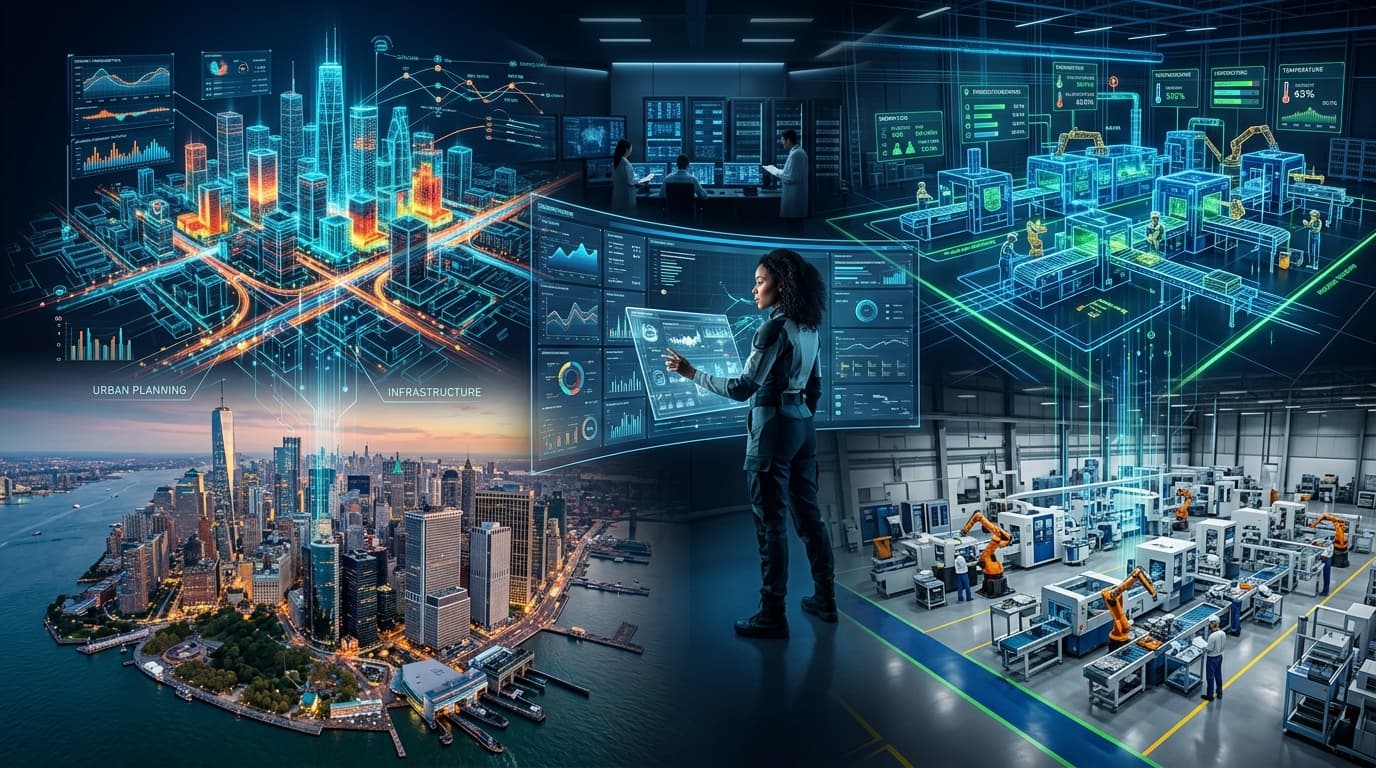
A digital twin is a real-time, high-fidelity virtual replica of a physical object, system, or process. Unlike a static 3D model or a CAD drawing, a digital twin is alive — continuously synchronized with its physical counterpart through sensors, telemetry, and data feeds. It doesn't just represent what something looks like; it models what something is doing, right now, and what it will do under any given condition.
The difference between a blueprint and a digital twin is the difference between a photograph of a person and a living conversation with them.
Anatomy of a Digital Twin
A digital twin is not a single technology — it's a convergence of several:
The Physical Entity
The starting point: a jet engine, a factory floor, a human heart, a city district. The physical entity is the source of truth. Everything the twin knows, it knows because of what the entity does.
The Sensor Layer
Embedded sensors — accelerometers, thermocouples, pressure gauges, LiDAR arrays, RFID tags, cameras — continuously sample the physical world. This data is the twin's nervous system. The density and quality of this sensor network determines how faithfully the twin reflects reality.
Modern IoT infrastructure enables thousands of simultaneous data streams from a single asset. A commercial aircraft, for instance, generates roughly 1 terabyte of data per flight, most of it from sensors monitoring engine performance, hydraulics, cabin pressure, and fuel flow.
The Data Integration Layer
Raw sensor data is noisy, heterogeneous, and often incomplete. The integration layer — typically a combination of edge computing and cloud pipelines — cleans, normalizes, fuses, and timestamps the data before feeding it to the twin.
This layer also handles data gravity: the tendency for analytical processes to migrate toward where large datasets live. Processing engine telemetry near the aircraft (edge) before sending summaries to the cloud is orders of magnitude more efficient than streaming raw bytes over satellite.
The Simulation and Modeling Engine
Here is where the twin becomes more than a mirror. Physics-based models — computational fluid dynamics, finite element analysis, thermodynamic equations — are embedded in the twin, allowing it to:
- Simulate counterfactuals: What would happen if this valve opened 15% wider?
- Predict failure: Given current wear rates, when will this bearing require replacement?
- Optimize in real-time: What is the most energy-efficient configuration for this HVAC system right now?
Increasingly, these physics models are augmented or replaced by machine learning surrogates — neural networks trained to approximate complex simulations at a fraction of the computational cost.
The Visualization and Interaction Interface
Digital twins need to be usable. Interfaces range from engineering dashboards and 3D web renderers to augmented reality overlays that let a technician see the twin superimposed on the physical asset through a headset.
The best interfaces collapse the distance between insight and action — showing not just what is happening, but what to do about it.
From Products to Systems to Cities
Digital twins exist at multiple scales, and the distinctions matter.
Component Twins
The most granular level: a single component modeled in high fidelity. A turbine blade, a cardiac stent, a battery cell. Component twins are typically used during design and R&D, allowing engineers to test thousands of material configurations or geometric variations without fabricating a single prototype.
Asset Twins
A complete physical asset — a wind turbine, a medical scanner, an industrial robot — modeled as a system of interacting components. Asset twins are the workhorse of predictive maintenance. By monitoring the health of each component in context, they can detect failure signatures that no single sensor would catch.
System Twins
Multiple assets interacting within a larger system: an assembly line, a power grid substation, a hospital's clinical workflow. System twins capture emergent behaviors — dynamics that only appear when components interact — and enable optimization at the process level.
System-of-Systems Twins
The most ambitious scale: entire cities, national infrastructure grids, ecosystems. Singapore's Virtual Singapore project is the most cited example — a semantically rich 3D model of the entire city-state, used for urban planning, emergency response simulation, and environmental impact analysis.
At this scale, the twin is less a replica and more a computational laboratory for policy.
Where Digital Twins Are Reshaping Industries
✈️ Aerospace and Defense
The aerospace industry was an early adopter, and it remains one of the most sophisticated users of digital twin technology.
GE Aviation pioneered digital twins for jet engines — each engine leaving the factory is paired with a virtual counterpart that follows it throughout its operational life. The twin tracks every flight cycle, temperature excursion, and pressure anomaly, allowing maintenance teams to schedule interventions based on actual wear rather than conservative fixed intervals.
The economic impact is significant. Condition-based maintenance enabled by digital twins can reduce unplanned downtime by up to 30% and extend component life by identifying engines that are operating well within safe margins — allowing operators to defer maintenance without increasing risk.
NASA applies the same logic to spacecraft. During a mission, telemetry from the vehicle continuously updates its digital twin. Mission controllers can simulate maneuvers and system failures before committing to real commands — a capability that has proven invaluable in anomaly response scenarios.
🏭 Manufacturing
Manufacturing is where digital twins have achieved the broadest commercial deployment. The concept of the smart factory — a production facility where every machine, workflow, and supply chain touchpoint is continuously monitored and optimized — is essentially a system-of-systems digital twin at industrial scale.
Siemens, one of the leading vendors in industrial digital twins, uses the technology internally at its Amberg electronics factory to achieve a defect rate of under 12 parts per million — a level of quality control that would be impossible without real-time process monitoring and closed-loop optimization.
Key applications include:
- Process optimization: Adjusting machine parameters in real-time to maximize yield and minimize waste
- Quality control: Detecting anomalies in production before defective products leave the line
- Commissioning: Virtually commissioning a new factory layout before any physical reconfiguration — testing workflows, identifying bottlenecks, training operators
- Supply chain resilience: Simulating the impact of component shortages or logistics disruptions before they materialize
🏗️ Construction and Infrastructure
The construction industry — historically resistant to digital transformation — has been drawn into the digital twin paradigm by the compelling economics of infrastructure failure.
A bridge that collapses costs not just money but lives. A building that requires unplanned structural remediation can run overbudget by orders of magnitude. Digital twins, built from BIM (Building Information Modeling) data and populated with structural health monitoring sensors, allow infrastructure managers to track the actual condition of assets against their design specifications throughout their operational lives.
The Øresund Bridge connecting Denmark and Sweden uses a network of accelerometers and weather sensors feeding a structural digital twin that models how wind, temperature, and traffic loads interact with the bridge's structural dynamics — alerting engineers when observed behavior deviates from predicted norms.
🏥 Healthcare and Medicine
Perhaps the most scientifically ambitious application of digital twins is the human body.
Personalized computational models of organs — hearts, lungs, kidneys — built from medical imaging, genomic data, and patient-specific physiological measurements can serve as testbeds for treatment planning. Before a surgeon implants a cardiac device, its interaction with a patient's specific heart geometry and electrophysiology can be simulated. Before an oncologist initiates a chemotherapy regimen, its predicted efficacy can be modeled against the patient's tumor biology.
The EU's Virtual Human Twin initiative — part of the broader European Human Brain Project and associated research programs — aims to develop clinically validated organ-level twins deployable in hospital settings. Early applications in cardiac surgery planning and prosthetic design have demonstrated measurable improvements in patient outcomes.
At the population level, epidemiological digital twins — computational models of cities or regions that simulate disease transmission dynamics — were thrust into the spotlight during the COVID-19 pandemic, when governments used agent-based simulations to evaluate intervention strategies before implementation.
⚡ Energy and Utilities
The energy transition — from centralized fossil-fuel generation to distributed renewable sources — is creating enormous complexity in grid management. Digital twins are emerging as a critical tool for navigating that complexity.
A wind farm digital twin models the aerodynamic interactions between turbines, allowing operators to adjust yaw angles to reduce wake losses — a subtle optimization that can improve farm-level energy yield by 2–4% with no additional hardware investment. At scale across thousands of installed turbines, those percentages translate to significant economic and environmental value.
At the grid level, National Grid ESO in the UK has deployed digital twin infrastructure to model transmission network behavior under a wide range of generation scenarios — critical for operating a grid where renewable generation introduces variability that coal and gas never did.
The Role of AI in Digital Twins
Digital twins and artificial intelligence are not the same thing, but they are increasingly inseparable.
Raw sensor data and physics simulations generate more information than human operators can interpret. AI layers — computer vision, anomaly detection, reinforcement learning, predictive modeling — are what transform a digital twin from a sophisticated dashboard into an autonomous intelligence that can identify patterns, predict futures, and recommend or execute actions.
The relationship also runs the other direction: digital twins generate the high-quality, labeled, physically grounded data that AI models need to train reliably. A digital twin of a manufacturing process can generate millions of synthetic training examples of normal and anomalous conditions — data that would take years and significant equipment damage to collect from the physical world.
This feedback loop — AI makes twins smarter, twins make AI more reliable — is one of the most generative dynamics in industrial technology today.
Challenges That Remain Unsolved
The digital twin field is advancing rapidly, but several hard problems persist.
Data Quality and Sensor Drift
A twin is only as good as its data. Sensors fail, drift, and produce outliers. Maintaining data integrity at scale — across thousands of sensors, over years of operation — is an engineering challenge that doesn't have elegant solutions. Robust digital twin deployments require sophisticated sensor fusion, anomaly detection, and graceful degradation strategies.
Model Validity and Uncertainty Quantification
Physics models make assumptions. Machine learning surrogates are approximations. Real systems operate in conditions that no model perfectly captures. A digital twin that doesn't communicate its uncertainty — that presents predictions with false precision — is potentially more dangerous than no twin at all.
Quantifying and propagating uncertainty through complex simulation chains remains an active research area, and best practices are not yet standardized.
Cybersecurity
A digital twin that controls physical systems is a cyberattack surface with physical consequences. Adversarial manipulation of sensor data could cause a twin to recommend actions that damage real equipment. Integrity verification for the data pipelines feeding digital twins is a nascent but critical field.
Interoperability and Standardization
The digital twin ecosystem is fragmented. Different vendors use proprietary data formats, incompatible APIs, and divergent ontologies. A manufacturer using Siemens tooling can't easily integrate with a supplier using PTC or Ansys. Standards bodies — including ISO, IEC, and the Industrial Internet Consortium — are working on this problem, but convergence is slow.
The Cost of Fidelity
High-fidelity twins are expensive to build and maintain. For many organizations, the ROI isn't clear — particularly for assets where failure is infrequent and consequences are manageable. Determining the right level of fidelity for a given use case — resisting the engineering temptation to model everything when modeling the critical few is sufficient — is a discipline that organizations are still developing.
The Philosophical Dimension
Digital twins raise questions that go beyond engineering.
If a digital twin of a city is sophisticated enough to predict the behavior of its inhabitants under various policy scenarios, what are the ethical implications of using it to optimize without resident consent? If a medical twin of a patient is used to make treatment decisions, who owns that model, and who is liable when it's wrong?
These questions aren't hypothetical. As digital twins approach greater fidelity and broader deployment, the gap between modeling the world and governing it begins to close in ways that deserve careful deliberate attention from ethicists, policymakers, and the public — not just engineers.
The most powerful models of the world, after all, have always carried within them the temptation to use the model as justification for shaping the reality it describes.
Conclusion: The Living Map
The Borges story imagines an empire that builds a map so detailed, so faithful to the territory, that the map eventually becomes the size of the empire itself — a futile and absurd project. Digital twins are not that map. They don't try to capture everything; they capture the right things, at the right resolution, in the right time.
What makes a digital twin genuinely new is not the simulation — engineers have been building simulations for decades — but the continuous synchronization. The twin doesn't drift away from its physical counterpart over time. It stays current. It stays honest. It is, in the truest sense, a living copy.
And living copies, it turns out, are extraordinarily useful. They let us test before we build, understand before we repair, predict before we fail, and — at their most ambitious — govern complex systems with a clarity that unaided human perception cannot achieve.
The real world, for the first time in history, has a thinking shadow. What we do with that shadow will define much of the next century of engineering, medicine, and urban life.