7 TypeScript Patterns That Make Your Codebase Scalable
Scalability isn't just about handling more users. It's about handling more developers, more features, and more time — without your codebase becoming a liability.
TypeScript gives you a powerful type system. But types alone don't make a codebase scalable — patterns do. The difference between a TypeScript project that ages gracefully and one that becomes a maintenance nightmare often comes down to a handful of structural decisions made early on.
These seven patterns aren't theoretical. They're battle-tested approaches used in large-scale production codebases that need to grow without falling apart.
1. Discriminated Unions for Explicit State Management
One of the most common sources of runtime bugs is impossible states — combinations of properties that shouldn't coexist but aren't prevented by the type system.
Consider a typical async data pattern written naively:
// ❌ Problematic: all states mixed together
interface FetchState {
  data?: User;
  error?: Error;
  isLoading: boolean;
}

// This is now valid — and wrong:
const brokenState: FetchState = {
  data: someUser,
  error: new Error("something failed"),
  isLoading: true,
};
All three fields are present simultaneously. The type allows it; your UI doesn't expect it.
Discriminated unions close this gap by making states mutually exclusive:
// ✅ Correct: states are mutually exclusive
type FetchState<T> =
  | { status: "idle" }
  | { status: "loading" }
  | { status: "success"; data: T }
  | { status: "error"; error: Error };

function renderUser(state: FetchState<User>) {
  switch (state.status) {
    case "idle":
      return <Placeholder />;
    case "loading":
      return <Spinner />;
    case "success":
      return <UserCard user={state.data} />; // data is always defined here
    case "error":
      return <ErrorMessage error={state.error} />;
  }
}
Share this article:
SPONSORED
InstaDoodle - AI Video Creator
Create elementAI Explainer Videos That Convert With Simple Text Prompts.
The discriminant field (status) lets TypeScript narrow the type in each branch. Inside case "success", TypeScript knows data exists. Inside case "error", it knows error exists. No optional chaining, no undefined checks — the type system does the work.
Why it scales: as your application grows and more developers touch these data flows, impossible states are prevented at compile time rather than discovered at runtime in production.
2. The Builder Pattern with Method Chaining
As configuration objects grow, constructors and plain object literals become unwieldy. The Builder pattern gives you a fluent API that's both type-safe and self-documenting.
class QueryBuilder<T extends Record<string, unknown>> {
  private filters: Partial<T> = {};
  private _limit: number = 50;
  private _offset: number = 0;
  private _orderBy?: keyof T;

  where(filter: Partial<T>): this {
    this.filters = { ...this.filters, ...filter };
    return this;
  }

  limit(n: number): this {
    this._limit = n;
    return this;
  }

  offset(n: number): this {
    this._offset = n;
    return this;
  }

  orderBy(field: keyof T): this {
    this._orderBy = field;
    return this;
  }

  build(): Query<T> {
    return {
      filters: this.filters,
      limit: this._limit,
      offset: this._offset,
      orderBy: this._orderBy,
    };
  }
}

// Usage: reads like English, type-checked at every step
const query = new QueryBuilder<User>()
  .where({ role: "admin" })
  .orderBy("createdAt")
  .limit(20)
  .build();
Notice the return type is this, not QueryBuilder<T>. This is critical for subclassing — if you extend QueryBuilder, the chained methods still return the subclass type, not the parent, preserving the fluent interface through inheritance.
Why it scales: adding new query options means adding one method to the builder. Call sites don't break. Complex query construction stays readable even as options multiply.
3. Branded Types for Domain Safety
TypeScript's structural type system means that two types with the same shape are interchangeable — even when they shouldn't be. This causes subtle bugs when you're working with IDs.
type UserId = string;
type PostId = string;
type CommentId = string;

function deletePost(id: PostId): void { /* ... */ }

const userId: UserId = "user_123";
deletePost(userId); // ✅ TypeScript is fine with this. You are not.
Branded types (also called opaque types) solve this by attaching a phantom type tag:
type Brand<T, B extends string> = T & { readonly __brand: B };

type UserId   = Brand<string, "UserId">;
type PostId   = Brand<string, "PostId">;
type CommentId = Brand<string, "CommentId">;

// Constructor functions act as the "gates" into branded territory
function createUserId(id: string): UserId {
  return id as UserId;
}

function createPostId(id: string): PostId {
  return id as PostId;
}

function deletePost(id: PostId): void { /* ... */ }

const userId = createUserId("user_123");
const postId = createPostId("post_456");

deletePost(postId);  // ✅ Correct
deletePost(userId);  // ❌ TypeScript error: UserId is not assignable to PostId
The __brand field doesn't exist at runtime — it's purely a type-level phantom. The as cast inside the constructor is the only place you bypass the type system, and you do it deliberately.
Why it scales: in a large codebase with dozens of entity types, branded IDs prevent an entire class of "wrong ID in the wrong place" bugs that are notoriously hard to catch in code review.
4. The Repository Pattern for Data Access
Scattering database queries or API calls throughout your codebase creates an unmaintainable tangle — every layer knows about your persistence mechanism, and changing it requires touching everything.
The Repository pattern centralizes data access behind an interface:
Your service layer depends on UserRepository, not on Prisma. Swapping the ORM, migrating to a different database, or running tests without a database — all require changing one line of dependency injection, not refactoring every service.
Why it scales: the interface is the contract. Everything downstream of it is isolated from the implementation detail of how data is actually stored.
5. Utility Types as a Design Language
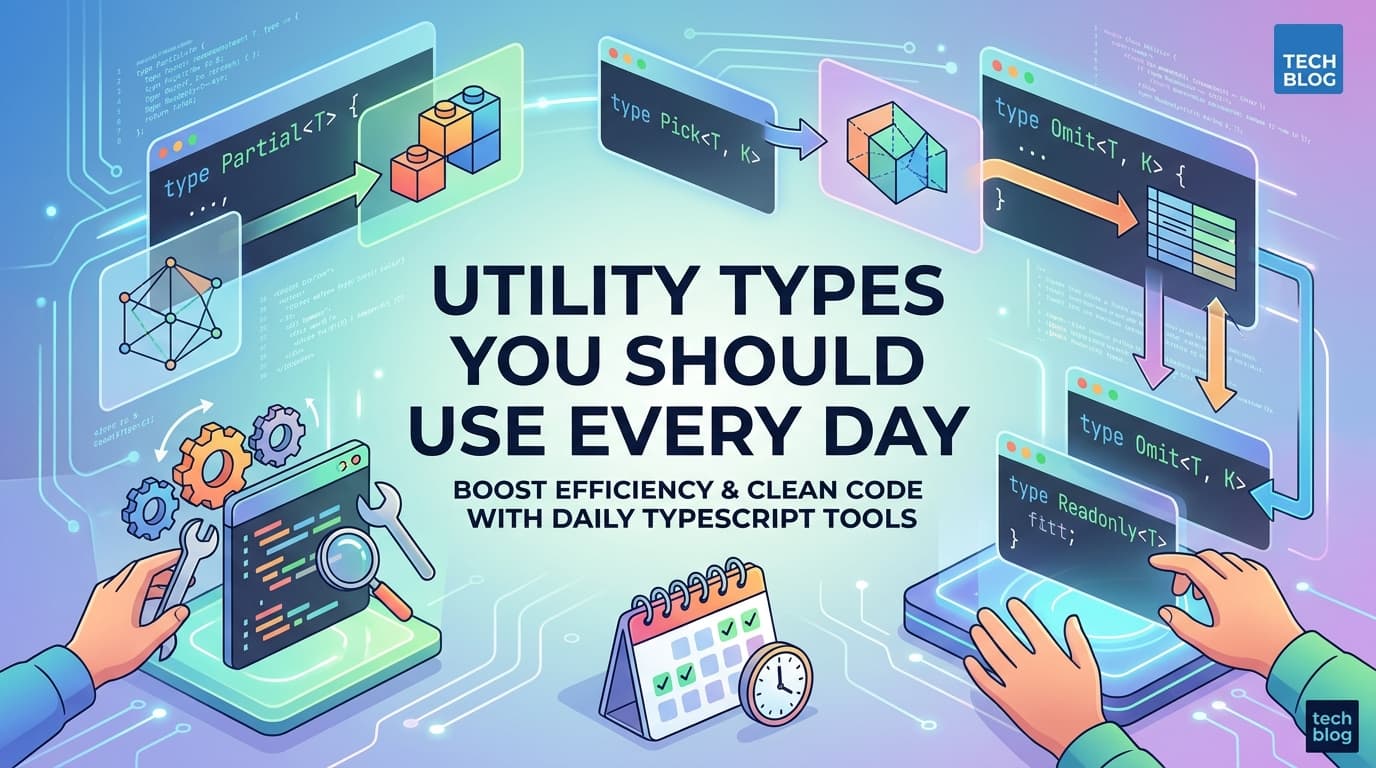
TypeScript ships with a rich set of utility types (Partial, Required, Pick, Omit, Readonly, etc.), but the real power comes from composing your own on top of them. This transforms types from passive annotations into an active design language.
// A common real-world pattern: different shapes for different operations
type User = {
  id: UserId;
  email: string;
  name: string;
  passwordHash: string;
  createdAt: Date;
  updatedAt: Date;
};

// What the API returns (never expose the hash)
type PublicUser = Omit<User, "passwordHash">;

// What you need to create a user (no generated fields)
type CreateUserInput = Omit<User, "id" | "createdAt" | "updatedAt" | "passwordHash"> & {
  password: string; // raw password, not hash
};

// What you allow updating
type UpdateUserInput = Partial<Pick<User, "email" | "name">>;

// Deep readonly for immutable config objects
type DeepReadonly<T> = {
  readonly [K in keyof T]: T[K] extends object ? DeepReadonly<T[K]> : T[K];
};

// Extract only the async methods from a class (useful for mocking)
type AsyncMethods<T> = {
  [K in keyof T as T[K] extends (...args: any[]) => Promise<any> ? K : never]: T[K];
};
Notice how CreateUserInput deliberately excludes passwordHash but addspassword. The type system encodes the business rule that you never accept a pre-hashed password from outside the system.
Why it scales: utility types let you derive types from a single source of truth — the User type. When User changes, all derived types update automatically. No synchronization drift.
6. The Module Barrel Pattern with Explicit Exports
As a codebase grows, import paths become a maintenance burden:
// ❌ This is what unmanaged imports look like at scale
import { UserService } from "../../services/user/UserService";
import { UserRepository } from "../../repositories/user/UserRepository";
import { CreateUserInput } from "../../types/user/inputs";
import { PublicUser } from "../../types/user/outputs";
import { validateEmail } from "../../utils/validation/email";
Barrel files (index.ts) create stable public APIs for each module:
// modules/users/index.ts
// Explicit: only export what's meant to be public API
export type { User, PublicUser, CreateUserInput, UpdateUserInput } from "./user.types";
export { UserService } from "./user.service";
export { InMemoryUserRepository } from "./user.repository"; // for testing
// UserRepository implementation detail stays private — not exported
// ✅ Clean, stable imports everywhere
import { UserService, type CreateUserInput } from "@/modules/users";
The key discipline is being explicit about what's public. Not everything in the folder gets exported. Internal helpers, private types, and implementation details stay hidden behind the barrel's boundary.
Why it scales: refactoring the internals of a module — renaming files, reorganizing folders, changing implementations — doesn't touch any external import. The barrel is the interface; the internals are free to evolve.
7. Satisfies Operator for Validated Literal Types
Introduced in TypeScript 4.9, the satisfies operator solves an elegant problem: how do you validate that an object conforms to a type without losing the specificity of its literal types?
type RouteConfig = {
  path: string;
  method: "GET" | "POST" | "PUT" | "DELETE" | "PATCH";
  auth: boolean;
};

type AppRoutes = Record<string, RouteConfig>;

// ❌ With a type annotation, TypeScript widens the types
const routes: AppRoutes = {
  getUser:    { path: "/users/:id", method: "GET",  auth: true },
  createUser: { path: "/users",     method: "POST", auth: false },
};

// routes.getUser.method is typed as string — not "GET"
// You've lost the specificity

// ✅ With satisfies, you get validation AND literal types
const routes = {
  getUser:    { path: "/users/:id", method: "GET",  auth: true },
  createUser: { path: "/users",     method: "POST", auth: false },
} satisfies AppRoutes;

// routes.getUser.method is typed as "GET" — exact literal preserved
// routes.unknownRoute would be a type error — validation still applies
This is particularly powerful for configuration objects, theme tokens, feature flags, and route definitions — anywhere you want the compiler to validate the shape while preserving the full specificity of the values.
// Practical example: theme tokens with satisfies
type ColorScale = Record<string, string>;
type Theme = { colors: Record<string, ColorScale>; spacing: Record<string, number> };

const theme = {
  colors: {
    primary: { 500: "#3b82f6", 600: "#2563eb", 700: "#1d4ed8" },
    danger:  { 500: "#ef4444", 600: "#dc2626" },
  },
  spacing: { sm: 4, md: 8, lg: 16, xl: 32 },
} satisfies Theme;

// theme.colors.primary[500] is typed as string — not string | undefined
// theme.spacing.sm is typed as number — not number | undefined
// theme.colors.nonexistent would be a compile error
Why it scales: configuration and constants are often the first things to drift as teams grow. satisfies gives you a compile-time contract on these values without sacrificing the autocomplete and narrowing benefits of literal types.
Putting It All Together
These patterns aren't independent techniques — they compose. A realistic module might combine all seven:
// Branded types (Pattern 3) for domain safety
type OrderId = Brand<string, "OrderId">;

// Discriminated union (Pattern 1) for state
type OrderState =
  | { status: "pending"; orderId: OrderId }
  | { status: "paid"; orderId: OrderId; paidAt: Date }
  | { status: "shipped"; orderId: OrderId; trackingCode: string }
  | { status: "cancelled"; orderId: OrderId; reason: string };

// Utility types (Pattern 5) derived from a single source
type Order = { id: OrderId; items: OrderItem[]; state: OrderState; /* ... */ };
type CreateOrderInput = Omit<Order, "id" | "state">;
type PublicOrder = Omit<Order, "internalMetadata">;

// Repository interface (Pattern 4) for data access
interface OrderRepository {
  findById(id: OrderId): Promise<Order | null>;
  save(order: Order): Promise<Order>;
}

// Builder (Pattern 2) for complex query construction
const orderQuery = new QueryBuilder<Order>()
  .where({ "state.status": "pending" })
  .orderBy("createdAt")
  .limit(100)
  .build();

// Barrel export (Pattern 6) makes this the public API
// satisfies (Pattern 7) validates config at compile time
The patterns reinforce each other. Branded types feed into repository interfaces. Discriminated unions compose with utility types. Barrels control the blast radius of any change.
The Underlying Principle
Every pattern here shares a common goal: make invalid states unrepresentable and valid states obvious.
Scalable codebases aren't built by writing more tests (though tests help). They're built by structuring code so that whole categories of bugs simply cannot exist — and so that the next developer who opens a file understands the constraints immediately, without needing to read documentation that may be out of date.
TypeScript's type system is powerful enough to encode most of your domain's invariants. These patterns are the vocabulary for doing that systematically — and keeping it maintainable as your team and your product grow.