The Question Everyone Is Asking — And Nobody Wants to Answer Honestly
Open any tech community forum today and you'll find some version of this thread: a CS student, a bootcamp graduate, or a self-taught developer asking whether it's even worth entering the field anymore. The replies are predictably polarized — seasoned engineers either dismissing the concern entirely ("AI can't think creatively, stop worrying") or amplifying it to doomsday proportions ("learn something else, the market is dead").
Both camps are wrong. Or rather, both are reacting to a question that's been imprecisely framed.
The real question isn't "Can AI write frontend code?" — it clearly can. The better questions are:
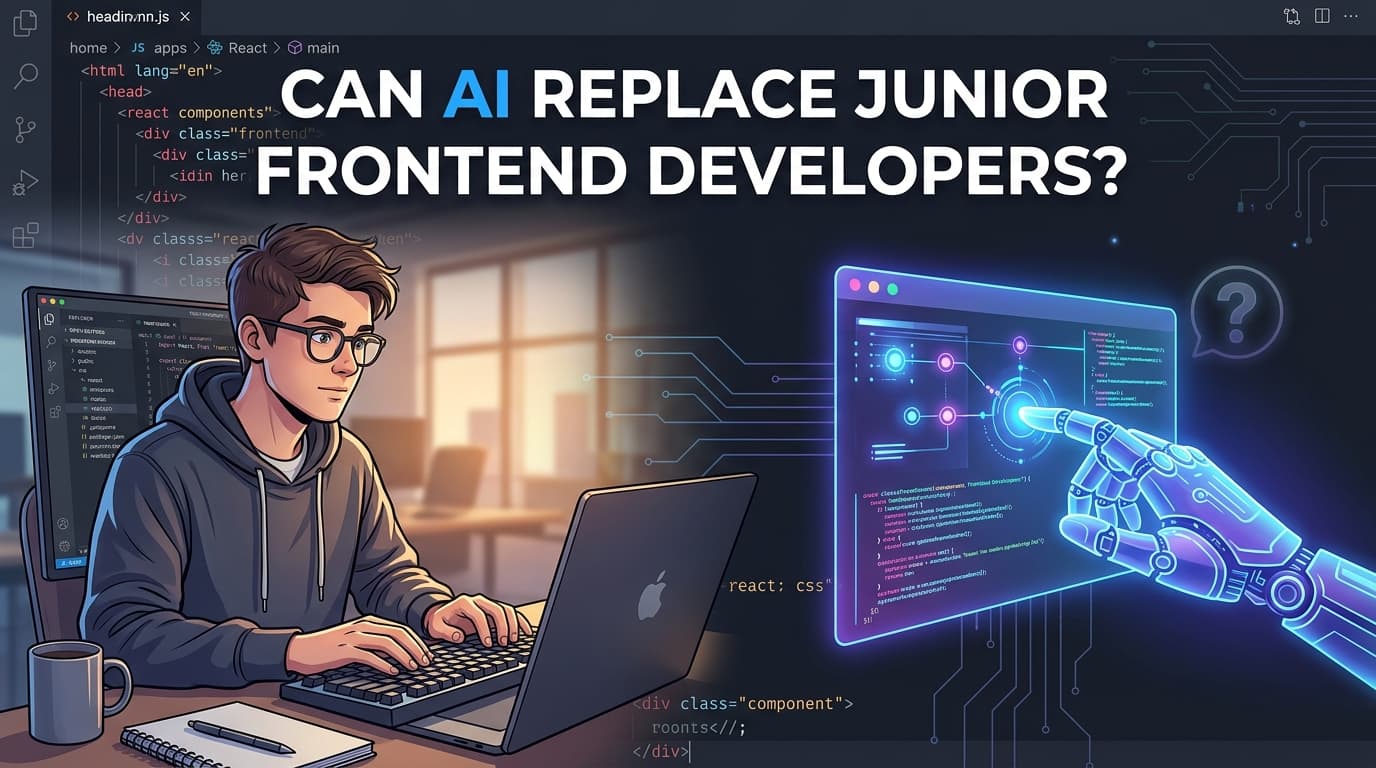
What does a junior frontend developer actually do?
Which of those tasks has AI already automated?
What does that mean for people entering the field right now?
Let's work through each honestly.
What Junior Frontend Developers Actually Do
Before debating replacement, we need to be precise about the role. "Junior frontend developer" is not a monolithic job description. Depending on the company, the stack, and the team structure, a junior dev's daily work might include:
Share this article:
Translating Figma designs into pixel-accurate HTML/CSS components
Wiring up REST APIs or GraphQL queries to UI components
Writing unit tests for existing components
Fixing bugs reported by QA or customers
Reviewing pull requests with guidance from seniors
Participating in sprint ceremonies and estimations
Refactoring legacy code under supervision
Learning — constantly, formally and informally
Notice something? Only a fraction of this list is pure code generation. A significant chunk is communication, judgment, and organizational navigation — understanding what the ticket actually means, asking the right clarifying questions, deciding when a bug is "fixed enough" versus when it signals a deeper architectural issue.
This distinction matters enormously.
What AI Has Already Automated (Be Honest)
Let's not be naive. AI coding tools — GitHub Copilot, Cursor, Claude, v0, Bolt — have genuinely automated or dramatically accelerated a significant portion of what junior frontend developers used to spend their time on.
✅ Component Scaffolding
Given a description or a screenshot of a design, modern AI tools can generate a reasonable first-draft React component in seconds. A task that once took a junior developer 45 minutes — setting up the file structure, writing boilerplate JSX, wiring up basic state — now takes a senior developer 3 minutes with AI assistance.
// Prompt: "Create a responsive card component with an image,
// title, description, and a CTA button. Use Tailwind CSS."

// AI generates this in ~4 seconds. Correctly.
export function ArticleCard({ image, title, description, href }: ArticleCardProps) {
  return (
    <div className="rounded-2xl overflow-hidden border border-zinc-200 hover:shadow-lg transition-shadow">
      <img src={image} alt={title} className="w-full h-48 object-cover" />
      <div className="p-6">
        <h3 className="text-xl font-semibold text-zinc-900 mb-2">{title}</h3>
        <p className="text-zinc-500 text-sm mb-4">{description}</p>
        <a href={href} className="text-blue-600 font-medium hover:underline">
          Read more →
        </a>
      </div>
    </div>
  );
}
✅ CSS Layout Tasks
Centering a div is a tired joke, but the serious version of this — complex grid layouts, responsive breakpoints, CSS custom property systems — is something AI handles well when given clear specifications.
✅ Boilerplate API Integration
Fetching data from an endpoint, handling loading and error states, basic caching patterns — these are well-trodden enough that AI generates them reliably.
✅ Writing Unit Tests for Simple Components
Given a component, AI tools can write a reasonable test suite covering the obvious cases. Not exhaustive, not creative, but functional.
✅ Translating Stack Overflow Answers
The archetypal junior task — "I don't know how to do X, let me search and figure it out" — has been partially superseded by asking an AI directly. The AI is faster, contextually aware, and doesn't require sifting through 14 outdated answers.
What AI Consistently Gets Wrong
Here's where the narrative needs to be more nuanced. AI's failures in frontend development aren't random — they cluster around predictable categories.
❌ Real Codebase Context
AI tools without full codebase access write code for a vacuum. They don't know that your team has a custom useAuth hook, that the design system uses a non-standard spacing scale, that the Button component requires a variant prop, or that three other developers have already tried to solve this exact problem and left comments explaining why the obvious approach doesn't work.
A junior developer who has been onboarded properly has this context. An AI tool — even with RAG over your codebase — partially has it. The gap still requires human judgment.
❌ Ambiguous Requirements
"Make this feel more premium" is not a spec. "The animation feels sluggish" doesn't tell you whether to adjust the duration, the easing function, or whether the issue is actually a dropped frame caused by a non-GPU-composited property.
Junior developers learn, through painful experience, how to translate vague human feedback into implementable technical decisions. This requires theory of mind — understanding what the stakeholder means even when they can't articulate it clearly. AI is improving here, but it still defaults to literal interpretations that miss the intent.
❌ Cross-Functional Communication
When a designer's mockup is impossible to implement within the performance budget, someone has to explain why and negotiate alternatives. When a product manager's requested feature conflicts with accessibility requirements, someone has to raise that conflict before sprint planning, not after launch. When a backend change breaks the frontend contract, someone has to bridge the gap between teams.
These are fundamentally human coordination tasks. AI can assist in drafting the communication, but it can't attend the meeting, read the room, or navigate the politics.
❌ Debugging Non-Obvious Issues
AI is excellent at debugging obvious issues — syntax errors, missing dependencies, well-known footguns. It struggles with emergent bugs: the race condition that only appears under a specific network latency, the z-index stacking context that only breaks on iOS Safari 16.3, the memory leak that manifests after 90 minutes of specific user behavior.
These bugs require hypothesis generation, systematic elimination, and often deep knowledge of browser internals or runtime behavior. This is precisely where experienced developers earn their pay — and where AI is a tool rather than a replacement.
❌ Aesthetic Judgment Under Constraints
Frontend development at its best is a discipline that sits at the intersection of engineering and design. Choosing the right animation curve. Knowing when a component is "good enough" versus when it needs one more iteration. Understanding that the technically correct implementation produces a subtly wrong visual result. These micro-judgments accumulate across a product to create the difference between software that feels polished and software that feels built by committee.
AI has aesthetic competence — it can produce visually acceptable output. It lacks aesthetic judgment — the ability to evaluate that output against unstated product values and human perception.
The Market Signal: What's Actually Happening to Hiring?
Let's look at the labor market rather than speculation.
The data from 2023–2025 shows a complicated picture. Junior developer hiring has unambiguously contracted at large tech companies — but this contraction began before the current generation of AI coding tools, driven by post-pandemic over-hiring corrections and rising interest rates compressing growth-stage startup funding.
AI tools have accelerated a trend that was already underway: senior developers have become dramatically more productive. A senior developer with Copilot or Cursor can handle tasks that previously required a junior developer — not because they're smarter, but because the mechanical translation work is now automated.
This creates a genuine squeeze at the entry level. Companies that might have hired two juniors and a senior now hire one senior with AI tooling. The junior roles aren't disappearing — they're consolidating.
At the same time, the total demand for frontend work has not decreased. The number of surfaces requiring frontend development — web apps, mobile web, embedded interfaces, AI-native products, design system components — continues to grow. The question is whether that demand growth will outpace the productivity gains from AI tooling.
The honest answer is: we don't know yet. And anyone claiming certainty in either direction is selling you something.
The Skills That Still Matter — And the Ones That Mattered Less Than We Thought
If you're entering the field, the AI transition is clarifying something that was always true but obscured by the scarcity of developers: some junior skills were always more valuable than others.
Skills that matter more now
Systems thinking — Understanding how components compose into features, how features compose into products, how technical decisions compound over time. AI can write a component; it can't reason about whether that component belongs in a shared library or a feature folder, and what the long-term implications of each choice are.
Debugging literacy — The ability to read error messages, interpret stack traces, use browser DevTools proficiently, and form hypotheses about failure modes. As AI generates more code faster, debugging that code becomes more important, not less.
Design sensibility — Understanding typography, spacing, color relationships, motion design, and accessibility not as checklists but as a coherent visual language. This is what elevates AI-generated output from functional to genuinely good.
Communication and collaboration — Writing clear tickets, asking precise questions, giving useful PR feedback, explaining technical constraints to non-technical stakeholders. These skills don't compress with AI tooling; they become more differentiating.
Prompt engineering and AI collaboration — Knowing how to work with AI tools effectively is genuinely a skill. Writing clear prompts, evaluating AI output critically, knowing when to trust it and when to rewrite it, and iterating efficiently are learnable skills that compound.
Skills that mattered less than we thought
Memorizing syntax and API signatures — This was always less important than the industry signaled. AI has made it irrelevant.
Writing boilerplate from scratch — The ability to set up a React project, configure Webpack, write the fifteenth version of a modal component. Valuable once for building intuition; now largely automatable.
Grinding LeetCode for its own sake — Algorithmic fluency matters for specific roles (runtime performance, complex data transformation). For most frontend work, it was credential theater.
What Junior Developers Should Actually Do Right Now
If you're early in your career or about to enter it, here's the most honest advice:
Ship things. The single most differentiating thing a junior developer can have in 2025 is a portfolio of real, deployed projects that solve real problems. Not tutorials completed, not courses finished — things that exist on the internet that someone uses. AI tools make this more achievable, not less. Use them aggressively.
Go deep on fundamentals. HTML semantics, the CSS cascade, the JavaScript event loop, browser rendering pipeline, HTTP and web APIs. Not because you'll use this knowledge every day, but because when something breaks in a way AI can't explain, this is what lets you debug it. Fundamentals are the floor AI output stands on.
Specialize early. The generalist junior developer is the hardest position to justify hiring for. A junior developer who has deep knowledge of animation and motion, or web accessibility, or performance optimization, or a specific framework ecosystem, has a much clearer value proposition.
Build in public. Write about what you're learning. Share your projects. Ask questions on GitHub discussions and Discord communities. The network effects of visible work compound faster than any individual skill.
Treat AI tools as collaborators, not shortcuts. The junior developers who will thrive are those who use AI to go faster while still understanding what the AI generated. Using Copilot to write a component you don't understand is a trap. Using it to write a component 3x faster than you could alone, while retaining full ownership of the code, is a superpower.
The Uncomfortable Conclusion
Can AI replace junior frontend developers?
For specific tasks: yes, already, extensively.
For the role in its full complexity: no, not yet, and not soon.
But "not yet" is doing real work in that sentence. The trajectory is clear: AI tools will continue improving. Tasks that require human judgment today will require less of it tomorrow. The frontier of what AI can do autonomously will keep advancing.
This means the path into frontend development is genuinely harder than it was five years ago — not because the skills are harder to learn, but because the value of certain skills has been compressed by automation. Entry-level work that was once a viable way to get paid while learning is less available.
The field is not dying. It is restructuring. The developers who enter it now will need to be more intentional about what they learn, faster to ship real work, and more comfortable working alongside AI tools as a fundamental part of their workflow.
That's a different entry path than 2019. It's not a closed door.
What do you think? The conversation about AI and the developer job market is moving fast — and the people closest to it have the most useful signal. If you're hiring, being hired, or somewhere in the middle, your experience is data.