The Long Road from ASIMO to Atlas
In 2000, Honda unveiled ASIMO — a 130 cm robot that could walk up stairs, wave at cameras, and capture the imagination of a generation. It was astonishing for its time. It was also almost entirely useless for real work. ASIMO spent most of its life doing press tours.
For the next two decades, humanoid robotics remained a domain of spectacular demos and limited deployment. The robots were too brittle, too expensive, too slow, and too rigid in their programming to operate reliably outside of controlled lab environments. Every variation in lighting, floor surface, or object placement was a potential point of failure.
Something shifted around 2022. The convergence of three independent advances — transformer-based perception models, massive simulation-to-reality (sim2real) training pipelines, and affordable high-torque actuators — began to close the gap between demonstration and deployment with startling speed.
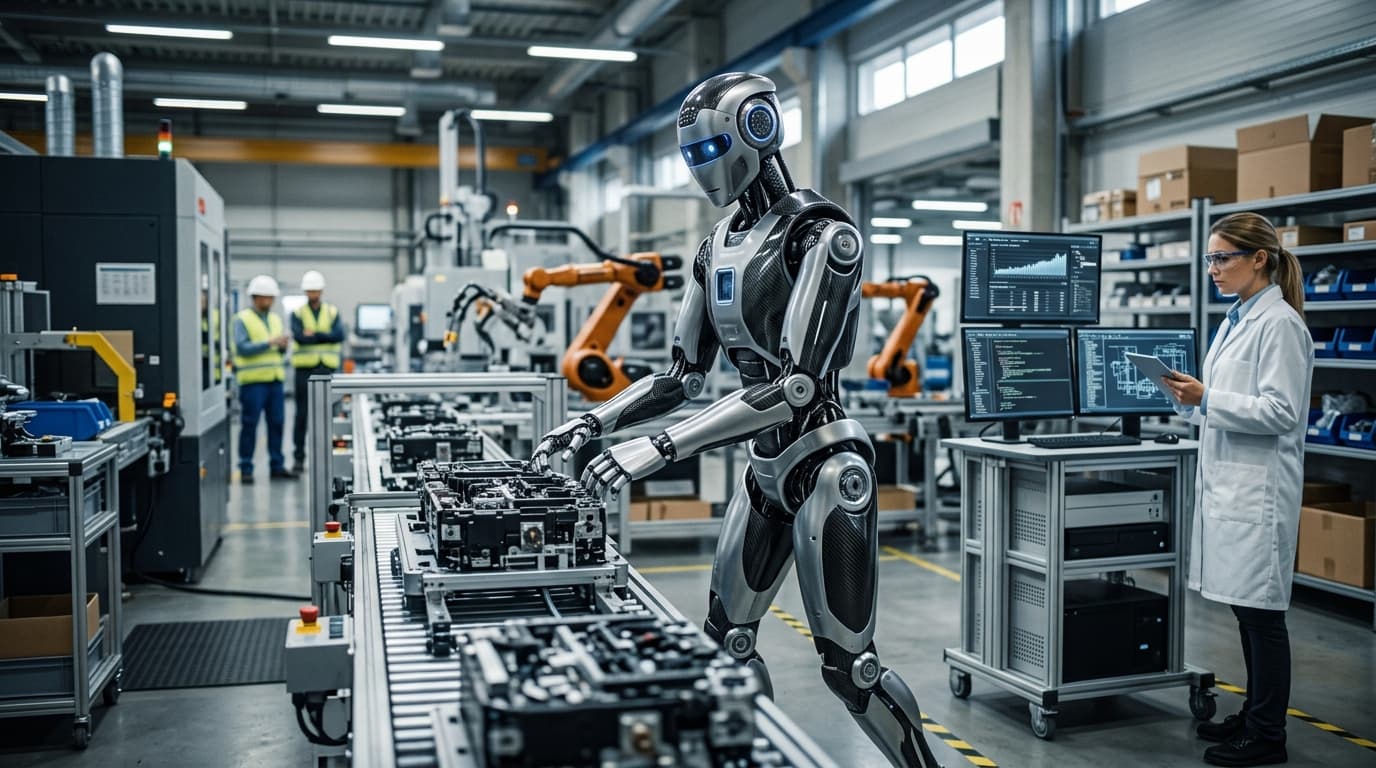
By 2025, humanoid robots were no longer the domain of university labs and defense research. They were on factory floors.
What Is "Physical AI"?
The term Physical AI describes AI systems that perceive, reason about, and act within the physical world — not just the digital one. It encompasses robotics broadly, but the humanoid form factor has become its most visible and contested frontier.
The distinction matters. A language model processes tokens. A vision model processes pixels. A Physical AI system must:
- Perceive the world through cameras, LiDAR, force sensors, proprioception, and tactile feedback — in real time
- Reason about spatial relationships, object permanence, task sequencing, and physical constraints
- Act with precision and force control through motors, joints, and end effectors
- Recover gracefully from unexpected events — a slipping object, an uneven surface, a human walking into its path
This last capability — robust recovery — is what separated lab demos from real deployments for so long. The world is not a controlled environment, and physical AI had to learn to cope with that.
The choice to build robots in human shape is not arbitrary sentimentality. It's a practical engineering argument — and a contested one.
The world was built for human bodies. Doorways, staircases, ladders, tool handles, vehicle interiors, keyboards, and workbenches are all dimensioned for a bipedal creature with two arms, hands with opposable thumbs, and a head at roughly 170 cm from the ground.
A robot designed to work alongside humans — in factories, warehouses, hospitals, construction sites — inherits enormous advantages from matching that form factor. It can:
- Use the same tools, without modification
- Navigate the same spaces, without costly infrastructure changes
- Be supervised and corrected by humans using familiar spatial language ("move that box to the left")
- Work in environments that can't be economically retrofitted for wheeled or fixed-arm robots
The Case Against
Critics argue that humanoid form is over-engineered for most industrial tasks. Bipedal locomotion is energetically expensive and mechanically complex. A fixed robotic arm on a gantry can outperform a humanoid in speed, precision, and uptime for repetitive tasks. Wheeled mobile manipulators can handle many logistics scenarios at lower cost and higher reliability.
The honest answer is that both arguments are correct — for different deployment contexts. The humanoid form factor earns its complexity when environmental versatility is the primary requirement. When the task is fixed and the environment is controlled, specialized robots win.
The reason humanoid robotics is attracting so much investment right now is a bet on the long game: that general-purpose physical intelligence, deployed in human-scale bodies, will eventually outvalue the entire ecosystem of single-purpose automation.
The Technology Stack: What Makes Modern Humanoids Work
Foundation Models for Robotics
The most consequential development in recent humanoid robotics isn't mechanical — it's the application of foundation model thinking to robot learning.
Traditional robots were programmed with explicit rules: "if object is at position X, move arm to position Y, close gripper with force Z." This worked in constrained environments but shattered on contact with variability.
Modern Physical AI systems learn from data — vast quantities of it — and develop generalizable policies that transfer across contexts. Key approaches include:
Imitation Learning / Behavior Cloning: Human operators teleoperate robots through target tasks while their actions are recorded. These demonstrations train a policy that the robot can then execute autonomously. Companies like Physical Intelligence (π) have scaled this to produce generalist robot policies that can fold laundry, bus tables, and sort objects — all from the same model.
Reinforcement Learning in Simulation: Robots are trained in physics-accurate virtual environments for millions of hours — far more experience than any physical robot could accumulate. The learned policies are then transferred to real hardware, a process called sim2real transfer. NVIDIA's Isaac Sim platform and Google's Mujoco have become critical infrastructure for this pipeline.
Vision-Language-Action Models (VLAs): Emerging architectures that unify language understanding, visual perception, and action generation in a single model. Google DeepMind's RT-2 and subsequent models demonstrated that language models pre-trained on internet data can bootstrap robot learning — a robot that understands "pick up the snack that hasn't been opened" has parsed language, visual context, and physical intent simultaneously.
Mechanical and Actuator Advances
Software alone doesn't make a functional humanoid. The hardware has had to keep pace:
- Series Elastic Actuators (SEA) and quasi-direct drive motors enable compliant, force-controlled movement — essential for interacting safely with humans and delicate objects
- Dexterous hands with 5+ degrees of freedom per finger are approaching the manipulation capability needed for real-world tasks; Sanctuary AI and Agility Robotics have made notable advances here
- Energy density improvements in lithium-polymer batteries have extended operational run times from under an hour to 4–8 hours on a charge
- Whole-body control algorithms allow the robot to coordinate legs, torso, and arms as a unified system rather than isolated subsystems
The Players: A Landscape in Motion
The humanoid robotics space has attracted an unusual mix of automotive giants, AI labs, and well-funded startups.
Founded in 2022, Figure has moved with exceptional speed. Their Figure 02 robot — deployed in a partnership with BMW at a Spartanburg, South Carolina manufacturing facility — performs automotive assembly tasks that were previously considered too variable for automation. Figure's collaboration with OpenAI to integrate large language model reasoning into robot decision-making produced early demonstrations of robots that explain their actions in natural language.
Tesla Optimus
Tesla's entry into humanoid robotics leverages its existing investments in computer vision (from Autopilot), custom silicon (the Dojo training cluster), and large-scale manufacturing. Optimus Gen 2 demonstrated significant improvements in walking speed, hand dexterity, and balance. Tesla has the manufacturing scale to make humanoids economically accessible in ways that pure robotics companies cannot — if they can solve the AI problem.
Boston Dynamics Atlas (Electric)
Boston Dynamics, long the gold standard for humanoid locomotion through its hydraulic Atlas platform, retired the hydraulic version in 2024 and unveiled an electric Atlas designed not for spectacle but for real work. The transition signals a shift from "what's mechanically possible" to "what's commercially deployable." Hyundai, which owns Boston Dynamics, is integrating Atlas into automotive manufacturing workflows.
Agility Robotics — Digit
Agility's Digit robot has a non-humanoid upper body but bipedal legs — an intermediate form factor optimized for logistics environments. Amazon has been piloting Digit in fulfillment centers for package handling. Digit represents a pragmatic path: human-like locomotion, purpose-built manipulation, real-world scale.
1X Technologies
Backed by OpenAI, Norwegian company 1X has focused on a different deployment model: placing humanoid robots (their NEO platform) in homes and offices rather than factories. Their bet is that the services market — companionship, elder care, household tasks — ultimately dwarfs the industrial market.
Unitree and the Chinese Ecosystem
Chinese robotics company Unitree has disrupted the market with dramatically lower-cost platforms. Their H1 and G1 humanoids are priced an order of magnitude below Western competitors, accelerating research access globally. A broader Chinese ecosystem — including Fourier Intelligence and UBTECH — is scaling rapidly, backed by significant state investment.
Real-World Deployments: What's Actually Happening
Beyond the demos, what is physically happening in the world today?
Automotive Manufacturing: BMW (with Figure), Mercedes-Benz (with Apptronik), and Hyundai (with Boston Dynamics) are running pilot programs that place humanoid robots alongside human workers on assembly lines. Tasks include parts transfer, quality inspection scanning, and subassembly operations.
Semiconductor Fabrication: The extreme cleanliness requirements of chip fabs make humanoid robots attractive — they don't shed skin cells or require bathroom breaks. Several fabs are evaluating humanoids for wafer cassette handling and equipment maintenance in cleanroom environments.
Warehouse Logistics: Amazon, GXO, and DHL are piloting bipedal and near-humanoid platforms for "goods-to-person" operations, handling the irregular objects and mixed-SKU environments that traditional conveyor-and-arm systems struggle with.
Construction: The construction industry — chronically labor-short and highly dangerous — is an attractive long-term target. Robots performing rebar placement, concrete finishing, and drywall installation are in early trials, though the unstructured nature of construction sites remains the hardest environment to crack.
Healthcare Support: Not clinical care, but logistics: transporting medications, linens, and equipment within hospital environments. The combination of human-navigable spaces and high labor costs makes hospitals an early adopter candidate.
The Challenges That Remain Unsolved
For all the progress, humanoid robotics still faces substantial open problems:
Dexterous Manipulation
Walking is largely solved. Picking up a crumpled piece of paper from a flat surface without a predefined grip plan is not. The human hand has 27 degrees of freedom and thousands of mechanoreceptors per square centimeter. Replicating this in hardware and software remains a fundamental research challenge.
Long-Horizon Task Execution
Current systems excel at short, well-defined tasks. "Assemble this bracket" is tractable. "Prepare a workstation for a shift change" — which involves dozens of subtasks, judgment calls, and implicit knowledge — is not. Long-horizon planning under uncertainty is an active research frontier.
Human-Robot Collaboration Safety
Robots working alongside humans need to be not just physically safe but predictably safe — humans need to be able to anticipate robot behavior. ISO/TS 15066 defines collaborative robot safety standards, but these were written for fixed-arm cobots, not bipedal humanoids with whole-body dynamics.
Cost
The best humanoid platforms currently cost $100,000–$300,000 per unit. For most deployment scenarios, this is prohibitively expensive. The path to mass adoption runs through manufacturing scale and commoditization of key components — the same journey that brought down the cost of industrial robot arms over the past 30 years.
Energy Efficiency
Human muscles are extraordinarily efficient. Electric motors in humanoid joints are not. Current platforms consume 300–500W during normal operation, limiting run times and raising operating costs. Improvements in actuator efficiency and energy recovery during locomotion are critical.
The Labor Question
No discussion of humanoid robotics can avoid the question that animates so much public anxiety: what happens to human workers?
The historical record of automation is complicated. It tends to eliminate specific tasks rather than whole jobs, while creating new categories of work that didn't previously exist. But it also tends to compress wages in affected sectors and accelerate inequality between workers who can adapt and those who cannot.
Humanoid robots are unusual because their general-purpose nature — unlike task-specific automation — could, in principle, substitute for a much broader range of human labor than previous waves of automation. A CNC machine replaced one kind of machinist task. A sufficiently capable humanoid could, in theory, replace entire job categories.
The honest assessment is that we don't know the net labor market impact at scale, because we've never deployed general-purpose physical AI at scale. Economists disagree vigorously. The outcomes will depend heavily on deployment speed, policy responses, and the degree to which new work categories emerge to absorb displaced labor.
What's clear is that the transition, when it comes, will not be gradual in all sectors simultaneously. It will be sudden in some industries and slower in others, creating acute local disruptions even if aggregate employment eventually adjusts.
The Road Ahead: A Realistic Timeline
Forecasting in robotics has a long history of embarrassment — the "10 years away" that stays 10 years away. With that caveat clearly stated:
2025–2027: Continued expansion of pilot programs in automotive and logistics. Unit economics improve but remain challenging. Early data on reliability and ROI shapes investment decisions.
2027–2030: First large-scale commercial deployments in structured industrial environments. Commodity hardware components drive prices below $50,000 for capable platforms. China exports low-cost humanoids globally, accelerating adoption.
2030–2035: Dexterous manipulation approaches human capability for a defined set of tasks. Robots enter less-structured environments — retail, healthcare logistics, light construction. The first signs of measurable labor displacement in specific sectors.
Beyond 2035: The trajectory becomes genuinely hard to predict. The gap between "capable in a factory" and "capable in an arbitrary human environment" may be larger than it currently appears — or it may collapse faster than anyone expects.
Conclusion: Bodies for Intelligence
For most of AI's history, intelligence lived in servers. It processed information, generated outputs, and handed them back to humans to act upon. The human body was the bridge between the digital and physical worlds.
Physical AI closes that loop. It gives intelligence a body — one that can reach into the physical world, manipulate it, and bear the consequences of its actions in real time.
The humanoid form factor is not just an aesthetic choice. It's an architectural bet: that the world will be easier to change through robots that fit into it than through environments redesigned around robots that don't.
Whether that bet pays off — and on what timeline — is the central drama of this decade in technology. The robots have left the lab. The question now is not whether they can work, but how fast the world is ready to put them to work.