A Lock That the Universe Guarantees
For most of computing history, cryptography has been a mathematics problem. The security of a message depends on the computational difficulty of solving a hard problem — factoring a very large number, or computing a discrete logarithm. These problems aren't theoretically impossible to solve; they're just practically impossible given the time and energy classical computers would require.
That "practically" has always been a bet.
Quantum cryptography is something different. Rather than asking "how hard is this math problem?", it asks a more fundamental question: what does physics prevent an adversary from doing?
The answer, rooted in quantum mechanics, is surprising and powerful. Quantum systems have properties — superposition, entanglement, the measurement problem — that make certain information-theoretic guarantees possible that no classical system can provide. Not "hard to break." Impossible to break, by the laws of nature as we understand them.
This is the promise. The reality, as always, is more complicated.
The Threat: Why Classical Encryption Is on Borrowed Time
The RSA Bet
In 1977, Ron Rivest, Adi Shamir, and Leonard Adleman published the RSA algorithm. Its security rests on a deceptively simple fact: multiplying two large prime numbers is easy, but factoring their product back into primes is extraordinarily hard.
To give a sense of scale: factoring a 2048-bit RSA key using the best known classical algorithms would take longer than the current age of the universe — even with every computer on Earth working in parallel.
RSA, and related systems like elliptic curve cryptography (ECC), underpin virtually all secure communication today. Every HTTPS connection, every encrypted email, every VPN tunnel, every digital signature relies on the assumption that factoring is hard.
Enter Shor's Algorithm
In 1994, mathematician Peter Shor published an algorithm designed to run on a quantum computer. Its target: integer factorization.
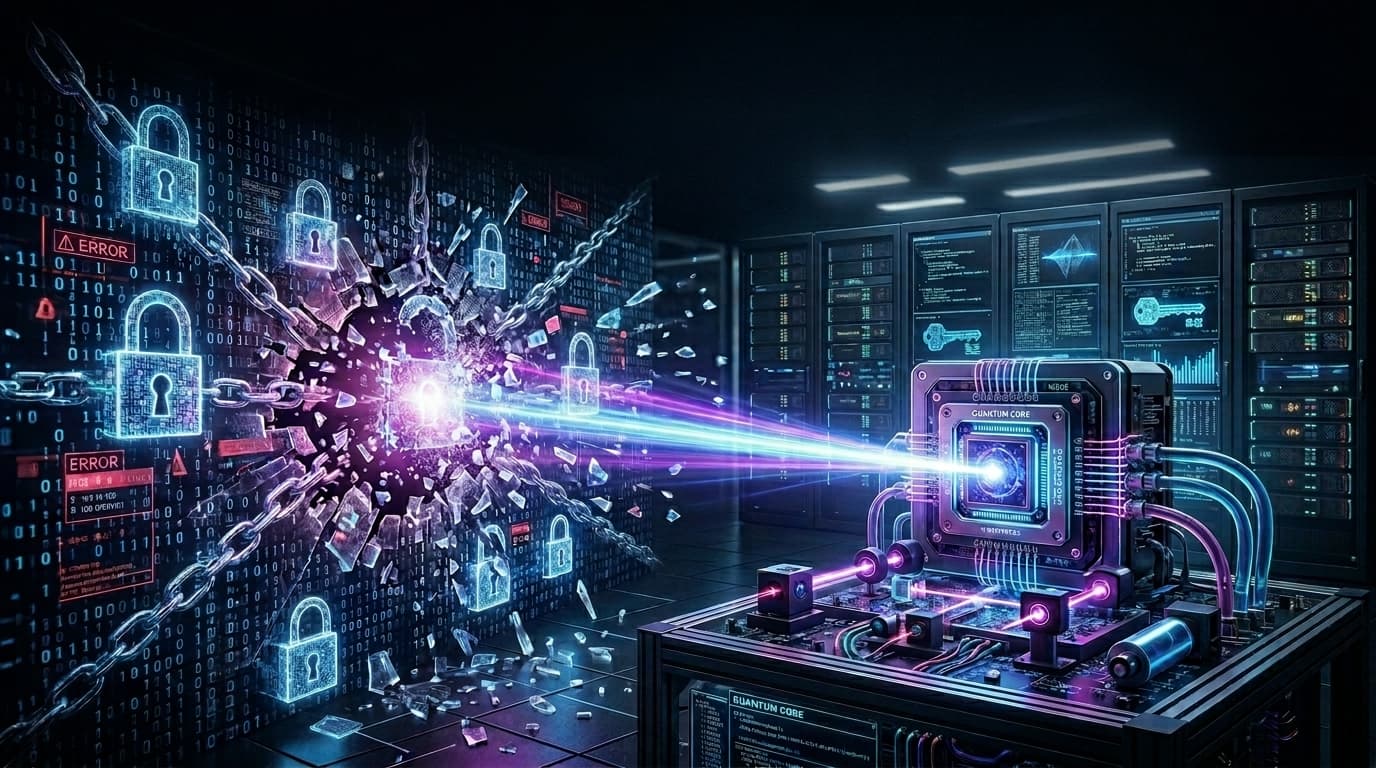
Shor's algorithm doesn't just improve on classical factoring — it obliterates it. A quantum computer running Shor's algorithm could factor a 2048-bit RSA key in hours or days, not geological timescales. The same algorithm, with modifications, breaks elliptic curve cryptography.
One algorithm. Nearly all asymmetric cryptography. Gone.
Shor's algorithm has been known for thirty years. The reason it hasn't ended the internet is simple: no quantum computer large enough and reliable enough to run it at scale exists yet. The keyword is yet.
The Harvest Now, Decrypt Later Threat
Nation-state adversaries don't need to wait until quantum computers are ready to act. They can intercept and archive encrypted traffic today and decrypt it later when the hardware catches up.
This is particularly alarming for data with long-term sensitivity: classified government communications, medical records, financial transactions, intellectual property, diplomatic cables. Information that needs to remain confidential for 10, 20, or 50 years is already at risk.
The US National Security Agency, NIST, and cybersecurity agencies across Europe have been issuing warnings about this threat since the mid-2010s. The urgency has only increased as quantum hardware has continued to advance.
Quantum Key Distribution: Security from Physics
Quantum Key Distribution (QKD) is the most mature branch of quantum cryptography. It addresses a specific, critical problem: how do two parties establish a shared secret key over an insecure channel, in a way that guarantees no eavesdropper has intercepted it?
The BB84 Protocol
In 1984, Charles Bennett and Gilles Brassard published what would become the foundational QKD protocol: BB84.
The core insight is quantum mechanical. A qubit — a quantum bit — can exist in superposition: simultaneously 0 and 1 until measured. Crucially, measuring a quantum state disturbs it. This is not a technological limitation; it's a consequence of the fundamental structure of quantum mechanics (the no-cloning theorem and the measurement postulate).
Here's how BB84 works, stripped to essentials:
- Alice (the sender) generates a stream of photons, encoding each in a random bit value using one of two randomly chosen measurement bases.
- Bob (the receiver) measures each photon using a randomly chosen basis.
- Alice and Bob publicly compare which bases they used (not the values). They discard measurements where their bases didn't match. The remaining bits form the raw key.
- They sacrifice a subset of the key to check for errors. If an eavesdropper (Eve) intercepted any photons, she necessarily disturbed the quantum states, and her interference shows up as anomalous errors in this check.
- If the error rate is below a threshold, no eavesdropper is present, and they proceed to derive a secure key. If it's above the threshold, they discard the key and start over.
The security guarantee is remarkable: any eavesdropping is detectable. Eve cannot copy the photons without disturbing them (no-cloning theorem). She cannot measure them without collapsing the quantum state. Her presence leaves a physical trace that Alice and Bob can detect.
This is security rooted in physics, not computational difficulty.
Alice ──[Photon Stream]──► Bob
         │
         │ (Eve intercepts)
         ▼
        Eve
         │ (disturbed photons continue)
         ▼
        Bob detects elevated error rate
         └──► Key discarded. Eavesdropping detected.
Beyond BB84: Modern QKD Protocols
BB84 has spawned a family of protocols addressing different threat models and practical constraints:
- E91 (Ekert, 1991): Uses entangled photon pairs. Security is derived from violations of Bell's inequalities — if the correlations between Alice and Bob's measurements violate Bell's inequality, no hidden-variable eavesdropper could have produced them.
- B92: A simplified two-state protocol. Easier to implement, but with a lower key generation rate.
- Continuous-variable QKD (CV-QKD): Encodes information in continuous properties of light (amplitude, phase) rather than discrete photon polarizations. Compatible with standard telecom infrastructure.
- Twin-Field QKD: Extends the viable transmission distance significantly by using interference between photons from Alice and Bob at a midpoint node.
Post-Quantum Cryptography: Defending Without Quantum Hardware
QKD requires quantum hardware to implement. Not every organization will have access to quantum communication channels in the near term. Post-quantum cryptography (PQC) — also called quantum-resistant cryptography — takes a different approach: design classical algorithms that Shor's algorithm (and other quantum algorithms) cannot efficiently attack.
In 2024, after an eight-year process, NIST finalized its first set of post-quantum cryptographic standards:
| Standard | Based On | Purpose |
|---|
| ML-KEM (CRYSTALS-Kyber) | Module lattice problems | Key encapsulation |
| ML-DSA (CRYSTALS-Dilithium) | Module lattice problems | Digital signatures |
| SLH-DSA (SPHINCS+) | Hash functions | Digital signatures |
| FN-DSA (FALCON) | NTRU lattice problems | Digital signatures |
These algorithms are designed to resist both classical and quantum attacks. Their security rests on mathematical problems — primarily lattice problems — that are believed to be hard even for quantum computers. Unlike integer factorization, no quantum algorithm (including Shor's) is known to efficiently solve lattice problems.
The migration to PQC is already underway. Apple integrated Kyber into iMessage's encryption in 2024 (PQ3). Google has been testing hybrid classical/post-quantum TLS. The US federal government has mandated PQC adoption across agencies.
The Quantum Internet: Entanglement at Scale
Beyond key distribution, quantum networking researchers envision a quantum internet — a global network over which quantum states can be transmitted and shared. This would enable not just secure communication, but fundamentally new capabilities:
Quantum Repeaters
A central challenge for QKD over long distances is photon loss. Standard optical fiber loses photons exponentially with distance; practical QKD links top out at roughly 100–200 kilometers without amplification. Classical optical amplifiers can't copy quantum states (no-cloning theorem again).
Quantum repeaters solve this through entanglement swapping and quantum memory. Rather than transmitting a single quantum state from A to B, repeaters establish entanglement between adjacent nodes and then "swap" that entanglement to extend the range — without ever copying the quantum state.
The Quantum Satellite Frontier
In 2017, China's Micius satellite demonstrated QKD between ground stations 1,200 km apart — and later, intercontinental QKD between China and Austria (7,600 km). These experiments used satellite-mediated entanglement distribution, bypassing fiber loss limitations entirely.
The European Quantum Internet Alliance and the US Department of Energy's quantum network testbeds are working toward intercontinental quantum-secured communication in the coming decade.
Blind Quantum Computing
One underappreciated application of quantum networks is blind quantum computing: a protocol that allows a client with limited quantum capabilities to delegate computation to a powerful quantum server — without the server learning what computation is being performed or what the inputs are.
This would be transformative for cloud computing security, allowing organizations to use quantum computing resources without exposing sensitive algorithms or data to the cloud provider.
Real-World Deployments: Where Is QKD Today?
Quantum cryptography is not purely theoretical. Commercial deployments exist today, though at limited scale:
China has the world's largest operational QKD network — a 2,000+ kilometer fiber backbone connecting Beijing, Shanghai, and several other cities, integrated with the Micius satellite. The network is used by government agencies, banks, and power grid operators.
Europe has the OpenQKD testbed, spanning multiple countries, and the EuroQCI (European Quantum Communication Infrastructure) initiative aims to deploy a pan-European quantum communication network by the end of the decade.
Toshiba, ID Quantique, QuantumCTek, and MagiQ Technologies are among the commercial vendors offering QKD hardware and systems today. Deployments include financial exchanges, government facilities, and research institutions.
South Korea and Japan both have operational metropolitan QKD networks and active deployment programs in critical infrastructure.
The technology exists. The challenge now is cost, scalability, and integration with existing infrastructure.
The Limits and Criticisms
Quantum cryptography is not a magic solution, and it has attracted serious technical and practical criticism.
Implementation Vulnerabilities
QKD is information-theoretically secure in theory. In practice, the physical implementations introduce vulnerabilities. Real photon detectors are not ideal; they can be blinded by strong laser pulses, manipulated to give a detector efficiency mismatch, or exploited through side channels that the abstract protocol doesn't model.
A 2010 paper by Lydersen et al. demonstrated a practical attack that compromised a commercial QKD system by exploiting detector blinding — without violating any quantum mechanical principle. The quantum channel was secure; the hardware was not.
This is a recurring theme: security proofs assume ideal components. Real components are never ideal.
Authentication Bootstrapping
QKD solves the key distribution problem, but it assumes Alice and Bob can already authenticate each other classically before the quantum exchange. If they can't, an adversary could mount a man-in-the-middle attack at the authentication layer — impersonating Bob to Alice and Alice to Bob.
Authentication requires a pre-shared secret or a classical PKI infrastructure. QKD doesn't eliminate the need for these; it shifts and reduces it.
Cost and Infrastructure Requirements
Deploying QKD requires dedicated optical fiber (or line-of-sight free-space optical links), specialized hardware at both endpoints, and significant operational expertise. It is expensive, point-to-point, and difficult to scale to the topology of the modern internet — which is a highly meshed network serving billions of endpoints simultaneously.
Some cryptographers argue that investing heavily in QKD infrastructure is premature, and that post-quantum cryptography (which runs on standard hardware) offers a more practical path to quantum resistance at scale.
The Quantum Computer Timeline Question
How urgent is the threat, really? The honest answer is: nobody knows. Credible estimates for cryptographically relevant quantum computers (CRQCs) — machines capable of running Shor's algorithm on 2048-bit keys — range from 10 years to "never in our lifetimes." Progress in error correction, qubit coherence, and fault tolerance has been rapid but uneven.
What's clear is that the prudent approach is to treat the threat as real and act accordingly — which NIST, NSA, and most major governments are now doing.
The Migration Challenge: Crypto-Agility
Perhaps the most underappreciated challenge is not technical but organizational: the migration from classical to post-quantum cryptography.
The internet is not a single system; it's a vast, heterogeneous accumulation of protocols, implementations, hardware, and embedded systems accumulated over decades. Many systems running today use cryptographic primitives from the 1990s. Medical devices, industrial control systems, satellites, and embedded firmware may have cryptographic code that cannot be updated at all.
Crypto-agility — the ability to swap cryptographic primitives without redesigning entire systems — is now considered a key property of well-engineered systems. The transition from SHA-1 to SHA-256, from TLS 1.0 to TLS 1.3, offers a preview of how painful these migrations can be even when the threat isn't imminent.
The quantum migration will be the largest cryptographic transition in the history of the internet.
What This Means for Different Stakeholders
For Governments and Defense
The threat is existential for national security. Harvest-now-decrypt-later attacks on classified communications are an immediate concern. Migration to PQC and eventual QKD deployment for the most sensitive links is a national security priority, not an IT upgrade.
For Financial Institutions
Long-term financial records, interbank settlement systems, and high-value transaction infrastructure are high-value targets. The financial sector is already engaged with NIST's PQC standards and beginning migration planning. The challenge is the long tail of legacy systems.
For Healthcare
Medical records are sensitive for a lifetime. A patient's genomic data encrypted today could be decrypted in 15 years by a quantum adversary. Healthcare providers need to understand that data encrypted today under RSA or ECC offers no long-term confidentiality guarantee.
For Enterprises and Developers
The practical implication for most developers is straightforward: begin transitioning to PQC-compatible cryptographic libraries now. Use hybrid encryption (classical + post-quantum) as a transitional measure. Audit cryptographic dependencies. Prefer systems and libraries that support crypto-agility.
The algorithms exist. The standards are published. The work of migration is engineering and organizational, not waiting for research.
Conclusion: The End of One Era, the Beginning of Another
Quantum cryptography does not mean the end of security. It means the end of a specific era — the era in which mathematical complexity alone was sufficient to guarantee confidentiality.
What comes next is a layered landscape: post-quantum algorithms providing computational security against quantum attacks, QKD providing physics-based guarantees for the most sensitive links, and quantum networks eventually enabling capabilities that aren't even fully imagined yet.
The transition will be long, expensive, and technically demanding. Some systems will not make it — legacy infrastructure will remain vulnerable for years. But the cryptographic community has been preparing for this moment for three decades, and the tools to navigate the transition exist.
The universe, it turns out, is willing to help keep secrets. We just have to learn to ask it correctly.
Further reading: NIST PQC Standards (FIPS 203/204/205) · Shor's Algorithm (1994) · Micius Satellite QKD · Apple PQ3 Protocol