From Dial-Up to Deep Learning: How Technology Reinvented the World
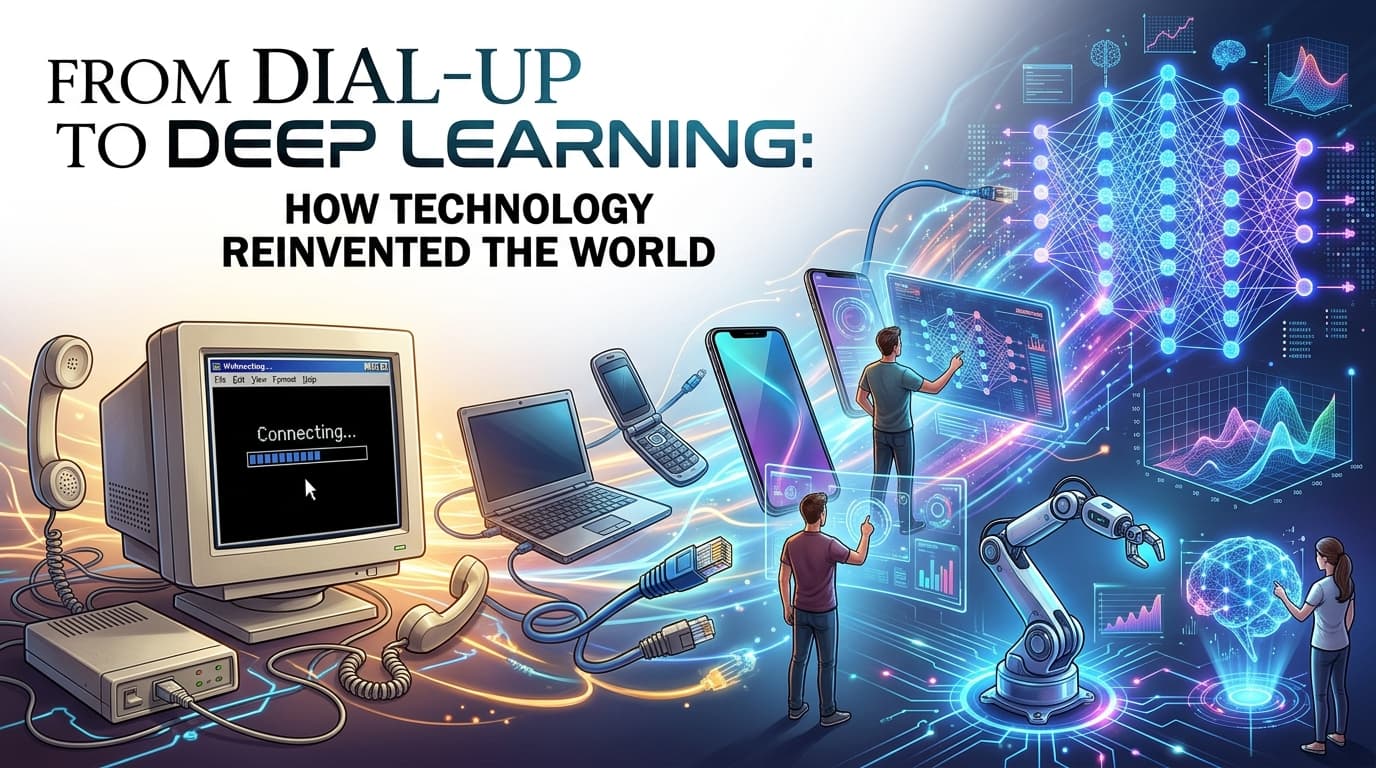
The 21st century compressed centuries of technological change into two decades. What started as blinking cursors on slow connections became the architecture of civilization itself.
The 21st century compressed centuries of technological change into two decades. What started as blinking cursors on slow connections became the architecture of civilization itself.
Timeline
Era
Years
Theme
🔵 Broadband & Search
2000–2005
Google rises, dial-up dies
🟢 Mobile Revolution
2006–2010
The smartphone reshapes everything
🟠 Social & Big Data
2011–2015
Networks, surveillance, consequences
🟡 Cloud & IoT
2016–2020
Invisible infrastructure, connected world
🟣 AI & Generative Era
2021–Now
Deep learning, large models, new minds
The Humble Beginning: Wires, Modems & the Open Web
At the turn of the millennium, the internet was a curiosity for most and a profession for few. Connecting online meant tolerating the shrieking handshake of a dial-up modem, waiting minutes for a single photograph to load, and praying nobody picked up the telephone. Yet beneath that fragile infrastructure lay an extraordinary ambition: a global, open network where information could travel freely.
Share this article:
SPONSORED
InstaDoodle - AI Video Creator
Create elementAI Explainer Videos That Convert With Simple Text Prompts.
Between 2000 and 2005, two forces changed the web's character permanently. Broadband penetration spread across North America and Europe, rendering dial-up obsolete almost overnight. And Google — still a graduate school project in spirit — quietly displaced every other search engine by returning results that were genuinely useful. The web stopped being an experiment and became a destination.
E-commerce followed. Amazon was still primarily a bookstore; PayPal was still fighting legal battles. But a new economic logic was emerging: if goods, services and information could travel through wires, geography would stop being destiny. Small businesses in rural towns gained the same storefront as corporations in Manhattan. The early web was, for a brief moment, radically democratic.
"The internet is becoming the town square for the global village of tomorrow."
— Bill Gates, 2004
The Phone in Your Pocket Changed Everything
No single product transformed the 21st century more completely than the smartphone. When Apple introduced the iPhone in January 2007, it did not merely release a new device — it redefined what a device could be. The computer, the camera, the map, the music player, the telephone: all collapsed into a glass slab thin enough to slide into a jeans pocket.
Google's Android platform followed within months, ensuring the smartphone revolution would not belong to a single company. Within five years, billions of people who had never owned a personal computer were connected to the internet for the first time — not through a desktop in a library or office, but through a device they carried everywhere, at all times. The internet stopped being somewhere you went and became something you simply were inside.
This had consequences nobody fully anticipated. Whole industries — taxis, hotels, record labels, map printers, travel agencies — were restructured or destroyed. Uber and Airbnb existed because the phone always knew where you were. Spotify existed because the phone could hold every song ever recorded. The mobile era didn't just accelerate technology; it relocated the center of economic gravity.
Key Numbers
6.9 billion smartphone users globally in 2024
$6 trillion in global e-commerce revenue by 2024
5.5 billion people online worldwide in 2025
The Social Decade: Networks, Data & Consequences
Social media did not emerge from nowhere, but it matured explosively in the 2010s. Facebook reached one billion users in 2012. Twitter became the nervous system of global news. Instagram taught a generation to see their lives as curated visual narratives. YouTube made video production democratic in a way television never was. The tools were free; the product, as the adage eventually recognized, was the user.
Underneath this cultural shift, something technically extraordinary was happening: the generation of data at a scale previously unimaginable. Every like, search, purchase, and location check-in produced a data point. Accumulated at planetary scale, this information became the raw material for a new kind of intelligence — pattern-finding algorithms that could predict what a person wanted to buy, watch, read, or vote for before that person consciously knew themselves.
The consequences arrived unevenly. Targeted advertising made small businesses more competitive; it also made disinformation campaigns surgically precise. Platforms optimized for engagement discovered that outrage traveled faster than nuance. By 2016, the phrase "social media" had acquired a shadow it has never fully shed.
Cloud, Code & the Invisible Infrastructure
While smartphones and social media occupied public attention, a quieter revolution was restructuring the entire technology industry. Cloud computing — the practice of running software and storing data on remote servers rather than local machines — transformed how companies were built. A startup in 2005 needed physical servers; a startup in 2015 needed a credit card and an Amazon Web Services account.
AWS, Microsoft Azure, and Google Cloud became the invisible infrastructure of the modern economy. The apps on your phone, the shows on your streaming service, the databases behind your bank: almost all of it runs on hardware that is owned by a handful of companies and distributed across dozens of data centers worldwide. Cloud computing democratized access to computing power while simultaneously concentrating control over it — a paradox that regulators are still working to understand.
The Internet of Things added a physical dimension to this digital expansion. Thermostats learned your schedule. Cars collected sensor data. Factories used connected machinery to predict maintenance failures before they occurred. The boundary between the physical world and the networked world began to dissolve — a process accelerating today in smart cities, connected medicine and autonomous vehicles.
The Age of Artificial Intelligence
If the smartphone was the defining technology of the 2010s, artificial intelligence is the defining technology of the 2020s — and perhaps of the century. The underlying ideas are not new: neural networks were theorized in the 1940s, and machine learning has been applied industrially for decades. What changed was scale.
The release of large language models to the general public — most dramatically with ChatGPT in late 2022 — made AI legible in a way it had never been. For the first time, a non-specialist could have a conversation with a system that could write, reason, code, translate, summarize, and create in ways that had previously seemed exclusively human. The response was extraordinary: a hundred million users in two months, a wave of investment, and a global conversation about what the technology meant for work, creativity, education, and truth.
Generative AI — systems capable of producing text, images, audio, video and code from natural language prompts — emerged as the most visible face of this shift. But the transformation runs deeper. AI is embedded in medical imaging analysis, drug discovery, materials science, climate modeling, and financial risk assessment. It is becoming, gradually but unmistakably, a general-purpose technology: one that amplifies nearly every other field of human activity.
"We may be approaching a moment when many instances of AI work autonomously in a way that could compress decades of scientific progress into just a few years."
— Dario Amodei, CEO, Anthropic — 2024
What Comes Next
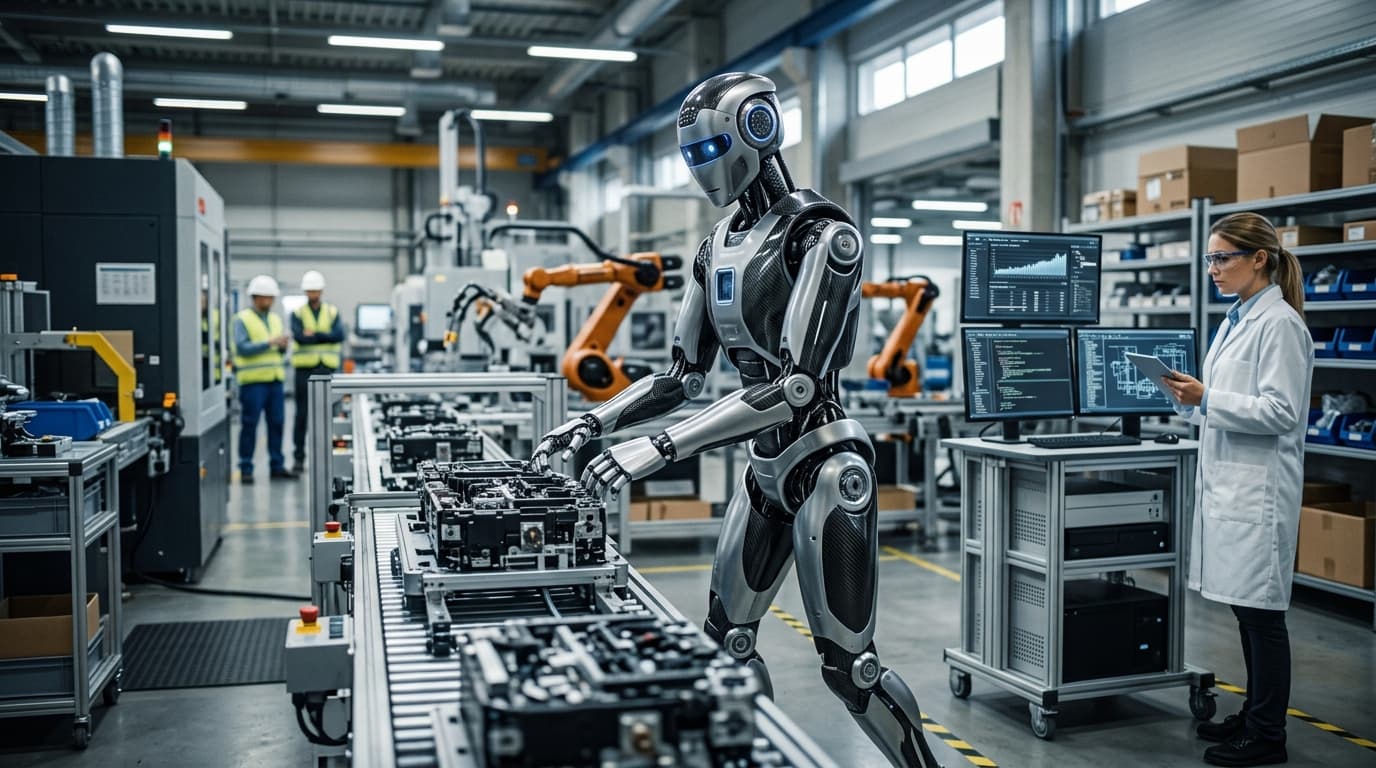
The pace of change makes prediction hazardous. Quantum computing promises to shatter current encryption while enabling simulations too complex for classical machines. Brain-computer interfaces are moving from laboratory curiosity toward clinical application. The next wave of robotics — informed by the same large models powering conversational AI — may finally deliver on automation's long-delayed promise in physical spaces, not just digital ones.
But technology's story is never only technical. Each era described here produced not just new tools but new social contracts, new concentrations of power, new vulnerabilities, and new forms of dependency. Broadband created platform giants. The smartphone created surveillance capitalism. Social media created information warfare. The lesson of the 21st century, so far, is that technological power distributes unevenly — and that the most important questions about technology are ultimately questions about governance, equity, and what kind of world we choose to build.
Twenty-five years after the millennium, we are still in the opening chapters. The internet began as a whisper through a telephone line. It has become the medium through which civilization increasingly conducts its business, keeps its memories, and argues about its future. What began as a tool is beginning to look, in some lights, like a new kind of mind.