How Technology Changed the Way We Live
The most profound technological shifts are not the ones that change what we can do — they are the ones that change who we are, how we relate, and what we expect from everyday life.
 ZextOverse
Loading articles...
The most profound technological shifts are not the ones that change what we can do — they are the ones that change who we are, how we relate, and what we expect from everyday life.
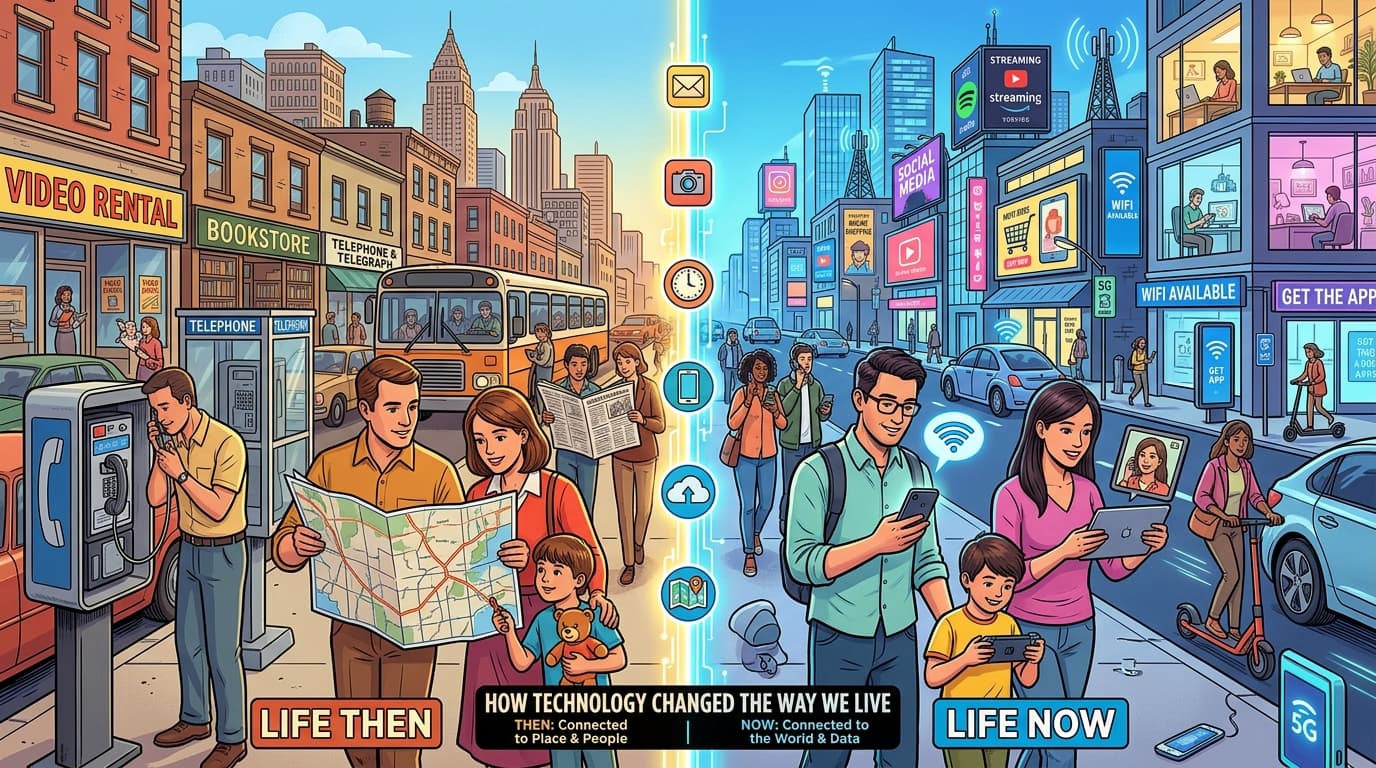
We tend to measure technological progress in product releases and market valuations. But the more honest measure is quieter and more personal: it lives in the moment a parent watches their child's school play through a phone screen from three thousand miles away, or in the strange intimacy of a two-year pandemic survived partly through video calls and next-day deliveries.
Technology in the 21st century did not just build faster machines. It reorganized time, space, attention, and human connection. The changes arrived so gradually — and then so suddenly — that most of us adapted without ever quite deciding to. This is the story of that transformation, told not in gigabytes and processor speeds, but in the texture of daily life.
For most of the 20th century, work meant a place. You commuted to it, spent eight to ten hours inside it, and left. The geography of work shaped the geography of everything else: where people lived, how cities were designed, when families ate dinner together.
Remote work did not begin with the pandemic — email, laptops, and broadband had been quietly making location optional for years. But 2020 forced a global experiment that no organization would have voluntarily commissioned. Almost overnight, hundreds of millions of knowledge workers moved their offices to their kitchens, bedrooms, and spare rooms. Video conferencing platforms became the new conference rooms. Slack and Teams replaced the corridor conversation.
What the experiment revealed was surprising. For many workers, productivity held up — and in some cases improved. Commute time, averaging over an hour a day in most major cities, was reclaimed. Parents could attend a child's afternoon recital without burning a vacation day. People with disabilities or chronic illness, long disadvantaged by the physical demands of office attendance, found themselves suddenly on equal footing.
But the costs were real too. The boundary between work and life, already blurring before the pandemic, dissolved further. Laptops on kitchen tables meant work was always within reach — and always within sight. Many workers reported longer hours, not shorter ones. Junior employees, deprived of the informal mentorship that happens in hallways and around coffee machines, struggled to develop at the pace their office-based predecessors had. Loneliness became a workplace problem.
"The office was never just a place to work. It was a place to belong."
— Widely noted observation from organizational psychologists, circa 2021
By 2026, most knowledge-economy organizations have settled into hybrid models — some days in person, some days remote — that reflect a genuine if unresolved tension between flexibility and connection. The commuter city is not dead, but it has been renegotiated.
The traditional model of education asked students to travel to a specific building at a specific time and receive knowledge from a specific person. For centuries, this was the only practical option. Technology has made it optional.
Online learning began modestly — correspondence courses digitized, lectures uploaded to university portals. Then platforms like Coursera, edX, and Khan Academy demonstrated that world-class instruction could be delivered for free or near-free to anyone with an internet connection. A student in Lagos could take a machine learning course from Stanford. A working mother in São Paulo could earn a professional certificate during her lunch break. Geography and wealth, long the primary determinants of educational access, began to loosen their grip.
YouTube accelerated this further in ways that formal platforms did not anticipate. Today, the world's most-watched tutorials are not produced by universities — they are made by individual creators who figured out how to explain calculus, speak Japanese, repair a carburetor, or cook a perfect risotto better than most textbooks do. The platform has become, for many people, their primary educational resource.
The pandemic years produced the largest forced experiment in remote schooling in history. The results were deeply uneven. In households with reliable internet, quiet workspaces, and engaged parents, children adapted and sometimes thrived. In households without those advantages — which meant a disproportionate number of lower-income and rural families — the consequences were severe. Learning gaps that may take years to close opened in months.
Technology expanded educational access. It also exposed, with uncomfortable clarity, how much access still depends on the analog world underneath the digital one.
There is a question worth pausing on: what did people do before smartphones? Before streaming? Before the feed?
They watched scheduled television, read physical newspapers, went to cinemas, and experienced long stretches of unstructured time that did not have a content delivery mechanism attached to them. Boredom — the productive, generative kind that precedes creativity — was a common part of daily life.
Netflix, YouTube, Spotify, and their successors changed the fundamental economics of entertainment. Content became effectively infinite and effectively free at the point of consumption. Appointment viewing — the shared cultural moment of a country watching the same program at the same time — gave way to fragmented, personalized consumption. Recommendation algorithms learned each viewer's preferences with unsettling precision, surfacing the next thing to watch before the current thing had finished.
The effects on culture have been complicated. On one hand, the diversity of available content exploded. Television's golden age — The Wire, Breaking Bad, Fleabag, Succession — was made possible partly because streaming economics could support niche audiences that advertiser-dependent broadcast television never could. International cinema, music from every tradition, and documentary journalism from corners of the world that network news ignored became accessible to anyone curious enough to look.
On the other hand, the attention economy — built on the premise that engagement is the product, and that outrage and novelty drive engagement better than anything else — has extracted a price. Average screen time among adults in developed countries now exceeds seven hours per day. Sleep has been compressed. Deep reading, which requires sustained attention incompatible with the interrupted rhythms of digital consumption, has declined measurably. Children who grew up with tablets from infancy are the first generation to have their attention architectures shaped entirely by algorithmic content delivery — and the long-term consequences are not yet known.
In 1995, if you wanted to tell someone something, you called them, wrote to them, or saw them in person. Each of these acts had a natural rhythm: calls interrupted; letters took days; visits required planning. Communication had friction, and friction imposed a kind of discipline.
The smartphone and the messaging app eliminated that friction almost entirely. WhatsApp, iMessage, Instagram DMs, Telegram, Snapchat — the platforms differ in design but share a fundamental premise: communication should be instant, available at any moment, and cost nothing. The result is that people are now, in a meaningful sense, continuously available to each other in a way that has no historical precedent.
This has genuine gifts. Families separated by oceans maintain daily intimacy. Friends who moved to different cities or different countries stay present in each other's lives in ways that geography once made impossible. In moments of crisis — a medical emergency, a natural disaster, a political upheaval — instant communication saves lives and coordinates response.
But continuous availability carries its own weight. The expectation of instant response has accelerated the emotional tempo of relationships. A message left unanswered for an hour can, in the logic of modern communication, read as a deliberate slight. The "seen" receipt — the small notification that your message has been read but not replied to — introduced a new and previously unimaginable category of social anxiety.
Social media added a performative layer to human interaction that earlier communication technologies did not have. Sharing a thought on Instagram or X (formerly Twitter) is not the same as telling a friend — it is performing for an audience, seeking validation through likes and engagement, and entering a competitive market of attention. Many people report a persistent sense of inadequacy when their lives are measured against the curated highlight reels that social platforms surface. The research linking heavy social media use to reduced wellbeing, particularly among adolescent girls, is by now substantial and hard to dismiss.
The word "dependency" carries a clinical connotation, but it is the right word. Most people in developed countries are now dependent on digital technology for navigation, banking, communication, work, healthcare access, entertainment, and social life in ways that would have seemed extreme — even alarming — two decades ago.
This dependency is not inherently sinister. Most useful technologies generate dependency: we depend on clean water systems, electrical grids, and refrigeration without considering those dependencies problematic. The question worth asking is not whether we are dependent on technology, but whether the terms of that dependency are ones we have chosen, or ones we have drifted into without realizing.
Several patterns are worth naming honestly. The average person checks their smartphone over 150 times per day. Sleep quality has declined across age groups, partly driven by the blue-light emission of screens and partly by the psychological difficulty of disconnecting from perpetually available information and social stimulation. Rates of anxiety and depression, particularly among young people, have risen substantially since the widespread adoption of smartphones — a correlation that is contested in its causal interpretation but too consistent to ignore.
At the same time, digital tools have demonstrably extended quality of life for millions of people. Telemedicine brings specialist care to patients in remote areas. Apps help people manage chronic conditions. Online communities provide belonging to people who would otherwise face profound isolation — the disabled, the housebound, those with rare conditions or minority identities living in hostile environments.
The honest picture is neither utopian nor dystopian. Technology has given us genuine power and genuine vulnerability in proportions that vary by age, income, geography, and disposition. Navigating that reality well requires something technology cannot provide: the judgment to know when to use it and when to step away.
We are not the first generation to live through technological disruption this profound. The printing press unsettled the authority of the Church. The industrial revolution dismantled centuries-old patterns of rural life. The telephone made the world smaller and faster. Each transition produced anxiety and wonder in similar measure, and each eventually settled into a new ordinary.
What distinguishes the current transformation is its pace and its intimacy. Previous technologies changed where people worked and how goods were made. Digital technology has changed what happens inside human attention, inside relationships, and inside the experience of being a person moving through time. That is a different kind of change — and it is still unfolding.
The question for the generation navigating it is not whether to participate in a technological world. That question has already been answered. It is how to remain the author of a life that technology serves, rather than the subject of a system that technology runs.
The screen is a window. The window is not the view.
Create elementAI Explainer Videos That Convert With Simple Text Prompts.
Learn More