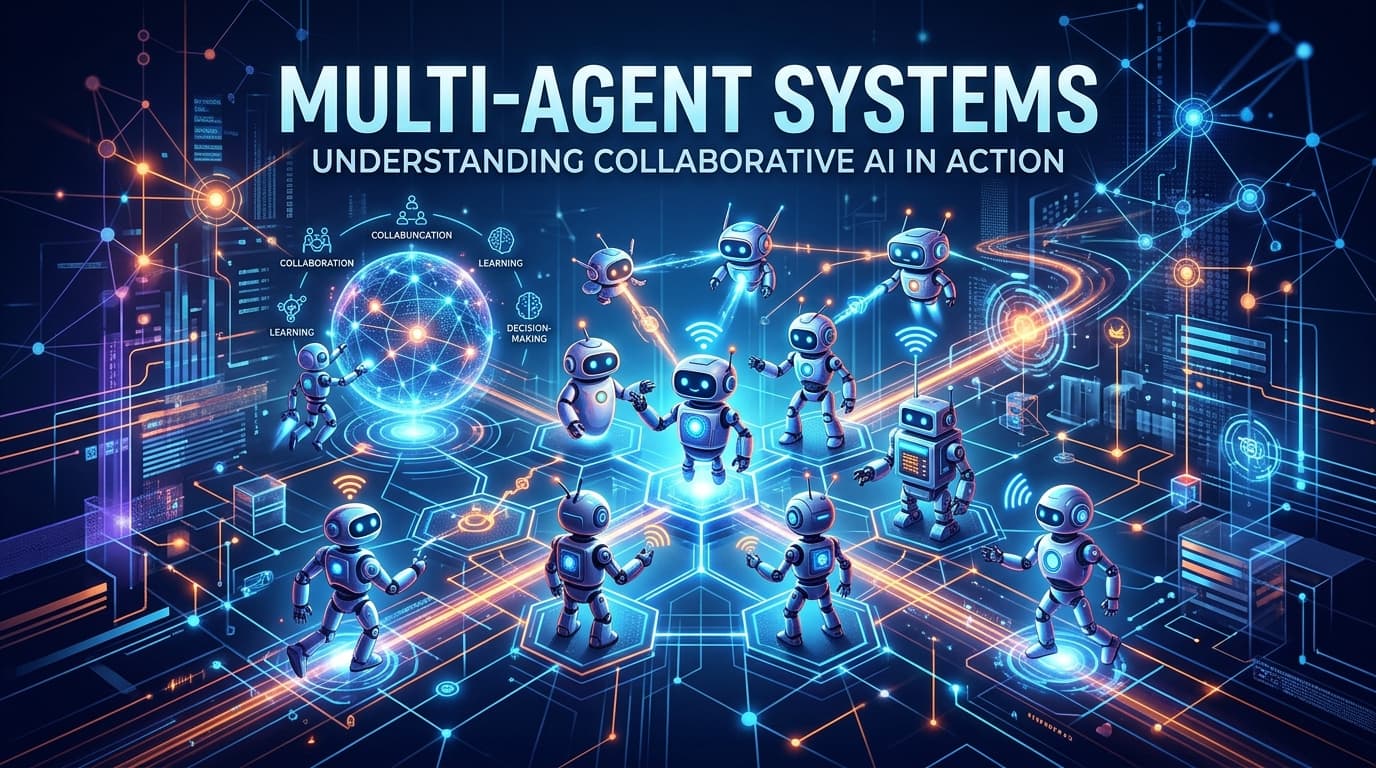
A single AI model answering a question is impressive. A network of AI agents collaborating, delegating, debating, and executing across an entire workflow — that is something categorically different. That is the architecture reshaping how software gets built.
There's a persistent myth in how we imagine intelligence: the lone genius locked in a room, emerging days later with the answer. History celebrates Newton under the apple tree, Einstein on his thought-experiment train. But look closer, and you find correspondence networks, collaborative labs, and generations of prior work.
Human intelligence, it turns out, is deeply social. We specialize, delegate, argue, verify, and build on each other's outputs. No single human mind runs a hospital, drafts legislation, or launches a satellite.
For most of the history of AI, the dominant paradigm was the opposite: one model, one task, one answer. You send a prompt; you get a response. The model is a black box — brilliant in some ways, brittle in others — but fundamentally solitary.
Multi-agent systems (MAS) break that paradigm entirely. Instead of asking "what can one model do?", they ask: what can a coordinated team of models accomplish?
The answers are starting to look remarkable.
What Is a Multi-Agent System?
A multi-agent system is an architecture in which multiple AI agents — each with their own role, tools, memory, and capabilities — work together to accomplish tasks that no single agent could reliably complete alone.
Share this article:
The key word is agents, not just models. An agent is a model that can:
Perceive its environment (read files, browse the web, query APIs)
Reason about what to do next
Act by calling tools, writing code, sending messages, or delegating to other agents
Remember relevant context across steps
When you connect multiple such agents in a coordinated system, you get something qualitatively different from a single model: a system with division of labor, error checking, parallelism, and emergent capabilities.
Think of it less like a smarter chatbot and more like a small software company — where different specialists handle research, writing, coding, review, and deployment, all working toward a shared goal.
The Anatomy of a Multi-Agent System
Multi-agent systems vary enormously in design, but most share a common set of structural elements:
Orchestrator (The Coordinator)
The orchestrator is the agent responsible for breaking down a high-level goal into subtasks and routing those subtasks to appropriate agents. It maintains the overall plan, tracks progress, and decides when the task is complete.
In some architectures, the orchestrator is a dedicated "manager" agent. In others, it's a human — a pattern sometimes called Human-in-the-Loop (HITL) orchestration.
Worker Agents (The Specialists)
Worker agents are optimized for specific functions. A typical system might include:
A research agent with web search and document retrieval tools
A code agent with access to a code interpreter and test runner
A writing agent tuned for tone, clarity, and formatting
A critic agent whose sole job is to find flaws in other agents' outputs
A memory agent that maintains long-term context and retrieves relevant past interactions
Each worker agent receives a well-scoped task, executes it, and returns results — much like a skilled contractor hired for a specific job.
Communication Layer
Agents need to pass information to each other. This happens through structured message passing — often in JSON or natural language — with protocols defining how requests are made, results are returned, and errors are handled.
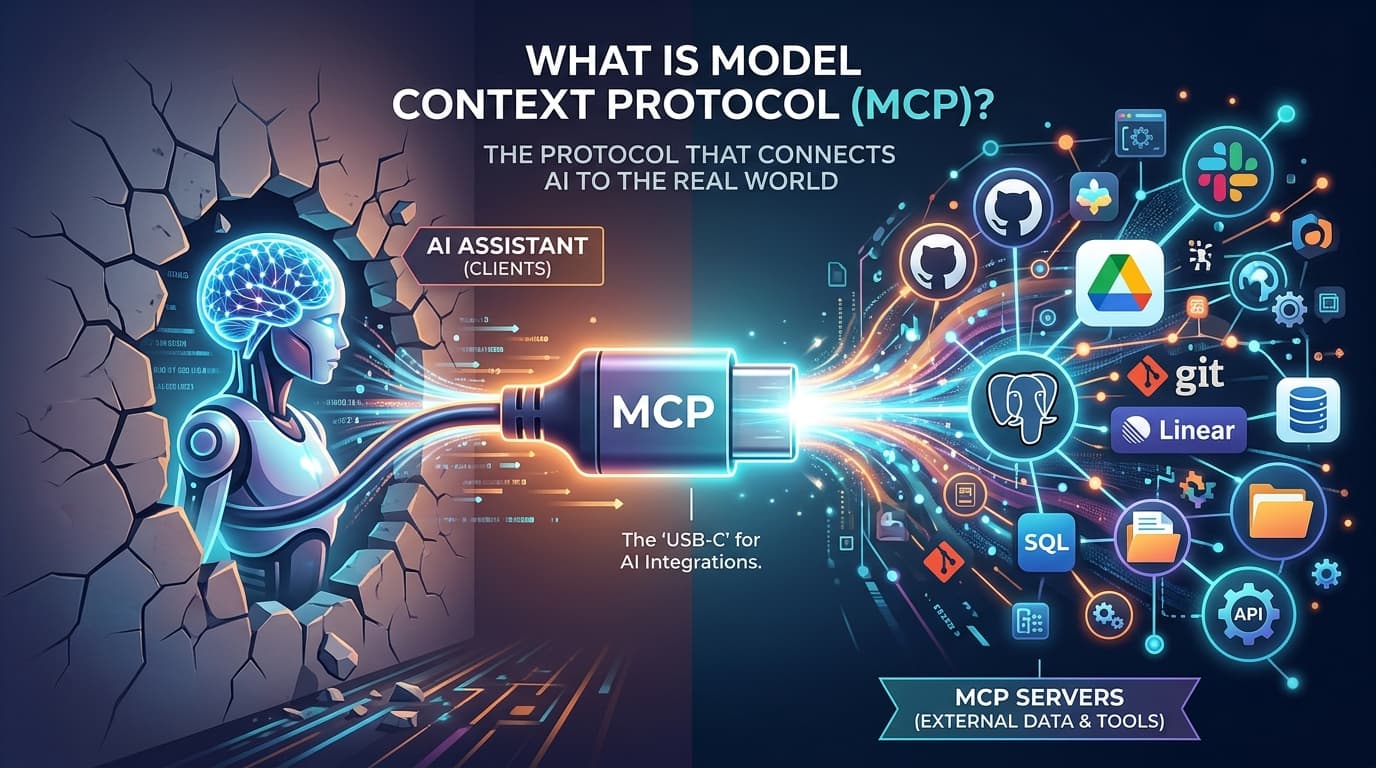
Emerging standards like Model Context Protocol (MCP), developed by Anthropic, are beginning to formalize how agents communicate with tools and with each other, making multi-agent systems more composable and interoperable.
Shared Memory and State
A critical challenge in multi-agent systems is context propagation. Individual agents have limited context windows. Shared memory systems — vector databases, document stores, or structured state objects — allow information produced by one agent to be retrieved and used by another without re-running expensive inference.
To understand why multi-agent systems matter, it helps to understand where single agents fail.
The Context Window Problem
Every language model has a maximum context window — the amount of text it can "see" at once. Even with modern models supporting 128K or 200K token windows, complex real-world tasks routinely exceed these limits. A legal due diligence review might involve thousands of pages of contracts. A software project might span hundreds of files.
Multi-agent systems solve this by distributing context. Each agent only needs to hold the slice of information relevant to its subtask. The orchestrator maintains a high-level view; workers maintain deep, narrow views.
The Reliability Problem
Ask a single model to perform a 50-step reasoning chain, and errors accumulate. Each step that's slightly off compounds the next, and the final output can be nonsensical — even if each individual step looked plausible.
Multi-agent systems introduce checkpointing and verification. A critic agent can review the research agent's output before it's passed to the writing agent. A test runner can validate generated code before it's deployed. Errors get caught early rather than propagated silently.
The Parallelism Problem
Sequential reasoning is slow. If a task requires gathering information from ten sources, synthesizing it, writing a draft, and revising it based on legal review — a single agent must do all of this in series.
Multi-agent systems unlock parallel execution. Research agents can gather information simultaneously. Multiple specialized models can process different document sections at once. Wall-clock time drops dramatically for complex tasks.
The Tool Specialization Problem
A general agent armed with every possible tool is often worse than a specialized agent armed with the right tools. A code agent with a REPL, a linter, and a debugger will write better code than a generalist with the same tools buried in a long list.
Role-constrained agents force focused, high-quality tool use within narrow, well-defined scopes.
Patterns of Collaboration
Multi-agent systems implement different collaboration patterns depending on the task structure:
Pipeline (Sequential Handoff)
Agent A → Agent B → Agent C → Output
Each agent processes the output of the previous one. Useful for tasks with clear sequential dependencies: research → outline → draft → proofread → publish.
Parallel Fan-Out and Merge
              ┌→ Agent A ─┐
Input → Split │→ Agent B ─├→ Merge → Output
              └→ Agent C ─┘
The orchestrator splits a task into independent subtasks, runs them in parallel, then synthesizes the results. Ideal for analyzing multiple documents, testing multiple hypotheses, or exploring multiple solution paths simultaneously.
Debate and Consensus
Agent A ──┐
          ├→ [Moderator] → Consensus
Agent B ──┘
Two or more agents independently tackle the same problem and then argue their conclusions before a moderator agent synthesizes the strongest answer. This pattern significantly improves accuracy on complex reasoning tasks by forcing explicit consideration of alternatives.
Research from Google DeepMind has shown that LLM debate — where models critique each other's reasoning — outperforms single-model answers on mathematical and logical problems, particularly when the models are encouraged to steel-man opposing views.
Hierarchical Delegation
CEO Agent
  └→ Manager Agent A
       └→ Worker Agent 1
       └→ Worker Agent 2
  └→ Manager Agent B
       └→ Worker Agent 3
Complex tasks decompose into sub-projects, each managed by an intermediate agent. This mirrors how human organizations handle large, multi-part projects and scales to genuinely complex, long-horizon tasks.
Real-World Applications
Software Engineering
Multi-agent coding systems are arguably the most mature application of MAS today. Systems like Devin (Cognition AI), SWE-agent (Princeton), and Claude Code (Anthropic) coordinate agents that can:
Read and understand large codebases
Write and execute code in sandboxed environments
Run test suites and interpret failures
Search documentation and Stack Overflow
Iterate on solutions based on test results
Open pull requests with appropriate descriptions
What makes these systems remarkable isn't any single capability — it's the coordination. A bug fix might require understanding the codebase architecture, identifying the root cause, writing a fix, running tests, fixing the fix, updating related documentation, and writing a clear PR description. A single model doing all of this sequentially is unreliable. A coordinated team of agents — each focused on its slice — succeeds far more often.
Scientific Research
AI research agents are beginning to assist with (and in some cases automate) parts of the scientific process:
Literature review: Agents scan thousands of papers, extract relevant findings, and synthesize them into structured summaries
Hypothesis generation: Agents identify gaps in the literature and propose testable hypotheses
Experimental design: Agents suggest protocols, controls, and statistical approaches
Data analysis: Agents process experimental results and flag anomalies
Paper drafting: Writing agents produce first-draft manuscripts from structured findings
Google DeepMind's AlphaFold represents an early, powerful example of a specialized AI solving a problem (protein folding) that resisted decades of human effort. The next generation extends this with coordinating teams of such specialized systems.
Business Operations
Enterprise use cases are expanding rapidly:
Customer support: A triage agent routes incoming requests to specialized agents handling billing, technical issues, or returns — each with access to relevant internal systems
Financial analysis: Research agents pull market data; analysis agents model scenarios; report-writing agents synthesize findings for human review
Supply chain management: Monitoring agents track inventory, logistics agents reroute shipments, communication agents notify stakeholders — all in response to a single disruption event
Creative Production
Even creative industries are experimenting with multi-agent workflows:
A story agent develops plot and characters; a dialogue agent writes conversations; a consistency agent flags internal contradictions; an editor agent refines prose style
In game development, agents generate content, test gameplay mechanics, balance difficulty, and write narrative — in parallel
The Challenges: What Can Still Go Wrong
Multi-agent systems introduce new failure modes alongside their new capabilities. Being clear-eyed about these is essential for responsible deployment.
Cascading Errors
If Agent A produces a subtly wrong output and Agent B builds on it without detecting the error, Agent C inherits a compounding mistake. This error propagation can produce confident, coherent-sounding final outputs that are deeply wrong. Critic agents and validation steps help, but don't eliminate the risk.
Coordination Overhead
More agents means more communication, more prompt tokens, more API calls, and more latency. Poorly designed multi-agent systems can be slower and more expensive than a single model for tasks that didn't actually require distribution. Good system design requires careful judgment about when to add agents and when not to.
Emergent Misalignment
This is the most subtle and important challenge. Individual agents, each individually aligned to be helpful and harmless, can collectively produce behaviors that none of them would produce alone. This emergent misalignment is an active area of AI safety research. When agents negotiate, delegate, and combine their outputs, new failure modes can arise that are genuinely difficult to anticipate.
Trust and Verification
When an orchestrator delegates to a worker agent, how does it verify the output is correct? When a worker calls an external API, how does the system know the API response is trustworthy? Multi-agent systems are only as reliable as their verification mechanisms — and those mechanisms are still nascent.
Cost at Scale
A complex multi-agent task might involve dozens of model calls, each consuming thousands of tokens. At current API pricing, ambitious multi-agent workflows can be expensive to run at scale. As inference costs continue to drop, this becomes less constraining — but it's a real consideration today.
The Human's Role: Oversight, Not Replacement
A recurring question about multi-agent systems is whether they reduce the human role to rubber-stamping AI outputs. The answer, for now at least, is emphatically no — and not just for safety reasons.
The most effective multi-agent deployments treat humans as critical checkpoints, not afterthoughts. Human review is inserted at high-stakes junctures: before code is deployed to production, before a legal filing is submitted, before a medical recommendation influences treatment.
This isn't a limitation of the technology — it's a feature. Multi-agent systems are at their most valuable when they dramatically accelerate human-directed work, not when they attempt to replace human judgment entirely. An analyst who once spent two weeks on a due diligence review might now spend two days — reviewing, refining, and making final calls on AI-generated analysis rather than performing the groundwork.
As trust is established through track record and verification, the human checkpoint can move further along the pipeline. But the appropriate level of autonomy for any given application must be earned, not assumed.
What's Coming: Toward Persistent Agent Networks
The multi-agent systems of 2025 are already impressive, but they're early prototypes of something potentially transformative. The trajectory points toward:
Persistent agents that maintain long-term memory and relationships — not just task-scoped conversations that vanish when the session ends, but agents with genuine institutional memory that accumulates over months and years.
Specialized agent marketplaces where organizations can deploy pre-built specialist agents (a HIPAA-compliant medical coder, a securities law analyst, a structural load calculator) and compose them into custom workflows without building from scratch.
Cross-organizational agent networks where an agent from one company can securely collaborate with an agent from another — negotiating contracts, exchanging information, and coordinating logistics with appropriate data governance guardrails.
Self-improving agent teams that can reflect on their own performance, identify systematic failures, and propose architectural improvements — with human approval — to their own coordination protocols.
Conclusion
The shift from single-model AI to multi-agent systems is more than an engineering evolution. It's a conceptual reorientation: away from the lone oracle that knows everything and toward something that looks more like a team, a firm, or an organization.
That shift brings profound capabilities — and profound responsibilities. The same coordination that allows a team of agents to solve complex problems also creates new failure modes, new alignment challenges, and new questions about accountability and oversight.
What seems clear is that the most difficult problems worth solving — in medicine, law, science, engineering, and governance — are not problems that one model will ever answer in a single forward pass. They're problems that require iteration, specialization, verification, and collaboration.
Multi-agent systems are how AI learns to work the way humans have always had to: together.