REST vs GraphQL: Which One Should You Learn?
Two philosophies walk into a backend. One brings a menu. The other asks "what do you want?" — and then fetches exactly that.
2026-04-04
 ZextOverse
Loading articles...
Two philosophies walk into a backend. One brings a menu. The other asks "what do you want?" — and then fetches exactly that.
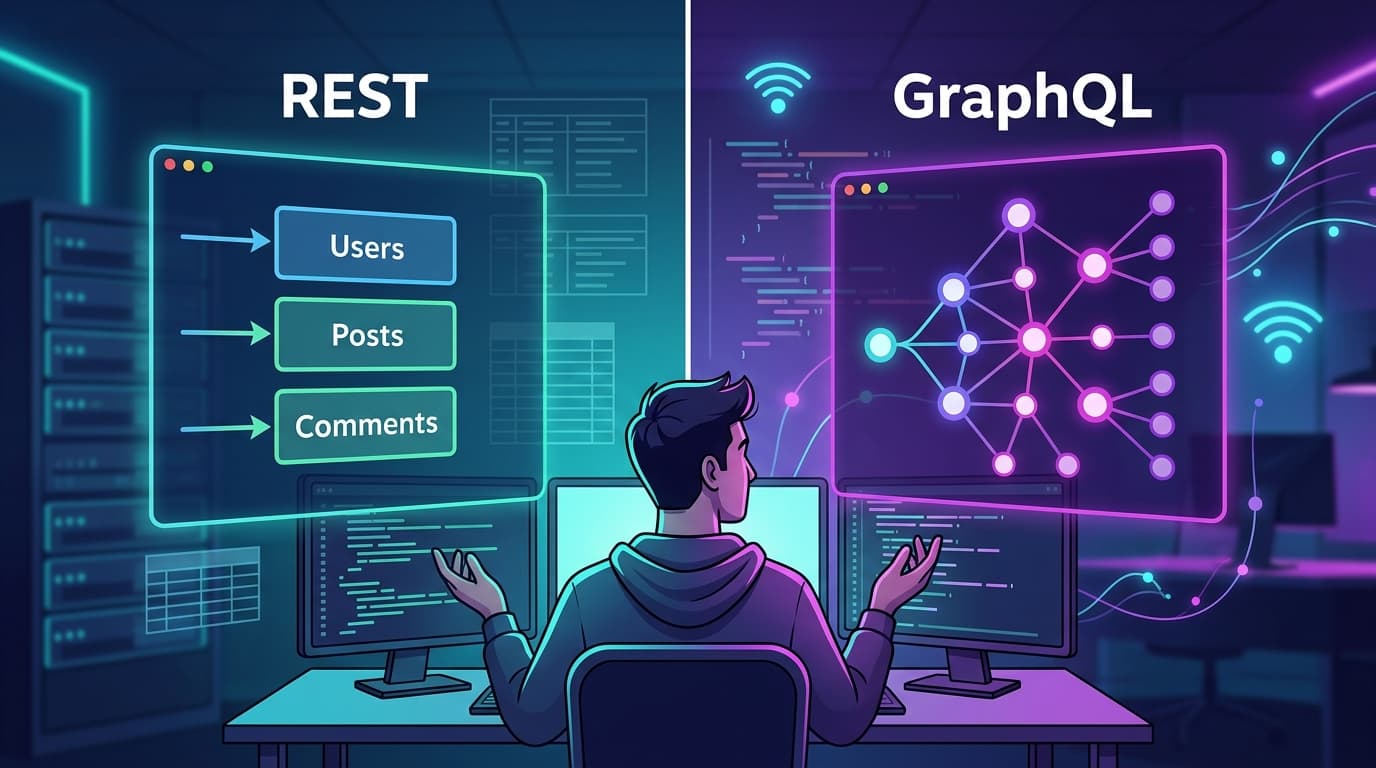
If you've spent any time in web development, you've heard both terms thrown around in job listings, tech Twitter arguments, and team architecture meetings. REST and GraphQL are both ways to design APIs — the communication layer between a frontend and a backend — but they approach that problem from fundamentally different angles.
The "which should I learn" question implies you can only pick one. You can't — and shouldn't. But understanding the trade-offs deeply will make you a better engineer regardless of which one you end up using day-to-day.
Let's break it down honestly.
REST (Representational State Transfer) isn't a protocol or a library — it's an architectural style, first described by Roy Fielding in his 2000 doctoral dissertation. It's built on top of HTTP and uses its verbs (GET, POST, PUT, PATCH, DELETE) to express intent, with URLs representing resources.
A classic RESTful API looks something like this:
GET    /users          → list all users
GET    /users/42       → get user with id 42
POST   /users          → create a new user
PUT    /users/42       → replace user 42
PATCH  /users/42       → partially update user 42
DELETE /users/42       → delete user 42
The mental model is nouns + verbs. Resources are nouns (users, posts, orders). HTTP methods are verbs. You navigate a hierarchy of resources using URLs. Responses are typically JSON (though REST itself doesn't mandate this).
In practice, real-world applications often expose the limits of REST's resource-centric model.
Over-fetching happens when an endpoint returns more data than you need. Fetching /users/42 might return 30 fields when your UI only needs name and avatar_url. That's wasted bandwidth, especially on mobile.
Under-fetching is the inverse problem. To render a user's profile page, you might need to call:
GET /users/42
GET /users/42/posts
GET /users/42/followers
GET /posts/17/comments
Four round trips to render one screen. This is the N+1 problem writ large.
Versioning is painful. When you need to change a response shape, you either break existing clients or maintain /v1/ and /v2/ endpoints in parallel — creating API debt that accumulates fast.
Tight coupling between frontend needs and backend endpoints means that every time a UI changes, the API might need to change too — requiring coordination across teams.
GraphQL was developed internally at Facebook in 2012 and open-sourced in 2015. It was born directly from the pain points of building the Facebook News Feed on mobile — a UI with extremely heterogeneous, deeply nested data requirements that REST handled awkwardly.
GraphQL is a query language for your API and a runtime for executing those queries. Instead of multiple endpoints for different resources, there's typically a single endpoint — and the client describes exactly what data it needs using a typed query language.
A GraphQL query for a user profile might look like:
query GetUserProfile($userId: ID!) {
  user(id: $userId) {
    name
    avatarUrl
    posts(last: 5) {
      title
      publishedAt
      commentCount
    }
    followers {
      count
    }
  }
}
One request. Exactly the fields you asked for. No more, no less.
GraphQL's power comes with real complexity costs.
Caching is hard. HTTP caching — which REST gets for free — relies on URLs as cache keys. With GraphQL's single endpoint and POST requests, you can't cache at the CDN or browser level without additional infrastructure (persisted queries, client-side caching with Apollo or urql).
N+1 problem shifts, not disappears. In a naive GraphQL server implementation, resolving nested fields can trigger an explosion of database queries. The standard solution — DataLoader — requires deliberate implementation and adds architectural complexity.
Complexity for simple APIs. If your API has five endpoints and straightforward data shapes, GraphQL is almost certainly overkill. You're adding a type system, a schema, resolver logic, and a query language for marginal benefit.
Security surface area. REST endpoints are explicit — you know exactly what each one does. GraphQL queries are dynamic and can be arbitrarily complex. A malicious or naive client can send deeply nested queries that take down your server. Query depth limiting, complexity analysis, and query cost budgets must be implemented explicitly.
File uploads: Not part of the GraphQL spec. You need multipart extensions or separate REST endpoints — an awkward seam in otherwise clean architectures.
| Dimension | REST | GraphQL |
|---|---|---|
| Mental model | Resources + HTTP verbs | Typed schema + flexible queries |
| Data fetching | Fixed response shapes | Client-defined fields |
| Over-fetching | Common problem | Solved by design |
| Under-fetching | Common (N+1) | Solved by design |
| HTTP caching | Native, effortless | Requires extra work |
| Learning curve | Low | Medium–High |
| Type safety | Via OpenAPI (optional) | Built-in, mandatory |
| Tooling maturity | Very high | High and growing |
| File uploads | Native | Requires workaround |
| Real-time | SSE / WebSockets (separate) | Subscriptions (built-in) |
| Versioning | URL versioning (painful) | Schema evolution (nuanced) |
| Best for | Simple/public APIs, microservices | Complex UIs, multiple clients |
Use REST. Public APIs are consumed by developers you've never met, using tools and languages you didn't anticipate. REST's simplicity, HTTP-native behavior, and universal familiarity lower the adoption barrier dramatically. Stripe, GitHub (partially), Twilio, and most major public APIs are REST-first for good reason.
Use GraphQL. A mobile app that needs minimal data for bandwidth reasons and a web app that needs rich relational data shouldn't have to share the same rigid endpoint shapes. GraphQL lets each client ask for exactly what it needs from a single backend.
Probably REST. The overhead of designing, maintaining, and securing a GraphQL schema adds up. In an early-stage startup, shipping speed often outweighs architectural elegance. You can always migrate later — and the GraphQL ecosystem has tools (like Hasura or PostGraphile) that can auto-generate a GraphQL layer over an existing database when you're ready.
REST tends to fit more naturally for service-to-service communication. Each microservice exposes well-defined HTTP endpoints. GraphQL can work here too — particularly as a BFF (Backend for Frontend) layer that aggregates multiple services — but it adds coordination overhead.
GraphQL shines. Social feeds, dashboards, e-commerce product pages with variants, reviews, and related items — these are the use cases GraphQL was born for. The ability to express complex, nested data requirements in a single typed query is a genuine productivity multiplier.
One of GraphQL's more sophisticated capabilities is schema federation — the ability to stitch multiple GraphQL services into a single unified graph. Apollo Federation, for example, lets different teams own different parts of the schema while clients interact with a unified API.
This is genuinely powerful for large organizations. Netflix, Airbnb, and Shopify use federated GraphQL architectures to give teams autonomy while maintaining a coherent data graph for their frontends.
It's also genuinely complex. If you're a team of four, federation is not your problem.
Let's be practical. Here's what the industry looks like in 2025:
If you're optimizing purely for employability: learn REST thoroughly first, then add GraphQL. The order matters because GraphQL is much easier to learn once you understand the problems it's solving.
REST isn't legacy. GraphQL isn't hype (anymore). They're different tools for different problems, and the best engineers know when to reach for each.
If you have to pick a starting point: learn REST first. It's the foundation. GraphQL makes no sense in a vacuum — it's a set of solutions to problems you'll only appreciate after you've felt the pain of over-fetching, N+1 round trips, and rigid endpoint contracts in a real codebase.
Once you've built something real with REST and hit its limits, GraphQL will click immediately. Not as a replacement, but as a tool that trades some of REST's simplicity for significantly more power in the right contexts.
The engineers worth hiring aren't the ones who swear by one approach. They're the ones who can articulate precisely why they'd use each — and then execute well.

Create elementAI Explainer Videos That Convert With Simple Text Prompts.
Learn More