Imagine hiring the most brilliant analyst in the world — someone who can synthesize information faster than anyone, reason across disciplines, and communicate with remarkable clarity. Now imagine locking them in a room with no internet, no files, no phone, and no way to access any external system.
That's essentially what most AI assistants have been, until recently.
Large language models (LLMs) are trained on vast corpora of text, giving them broad knowledge frozen at a point in time. But when you actually deploy them in a real workflow, you want them to read your documents, query your database, open your tickets, and interact with your tools — not just recite what they learned during training.
Before a universal solution existed, the answer was custom integrations: if you wanted Claude to access Slack, you built a Slack connector. If you wanted it to read from Postgres, you built a database tool. If you wanted it to check GitHub, you built another connector. And every one of those connectors was bespoke, fragile, and non-transferable to another model or application.
Engineers recognized this as what's sometimes called an M×N problem: connecting M different AI applications to N different data sources required up to M×N custom integrations. As AI adoption scaled, this became untenable.
Share this article:
The Model Context Protocol (MCP) is the answer to that problem.
What Is MCP?
MCP is an open protocol — a standardized set of rules that defines how AI applications communicate with external data sources and tools.
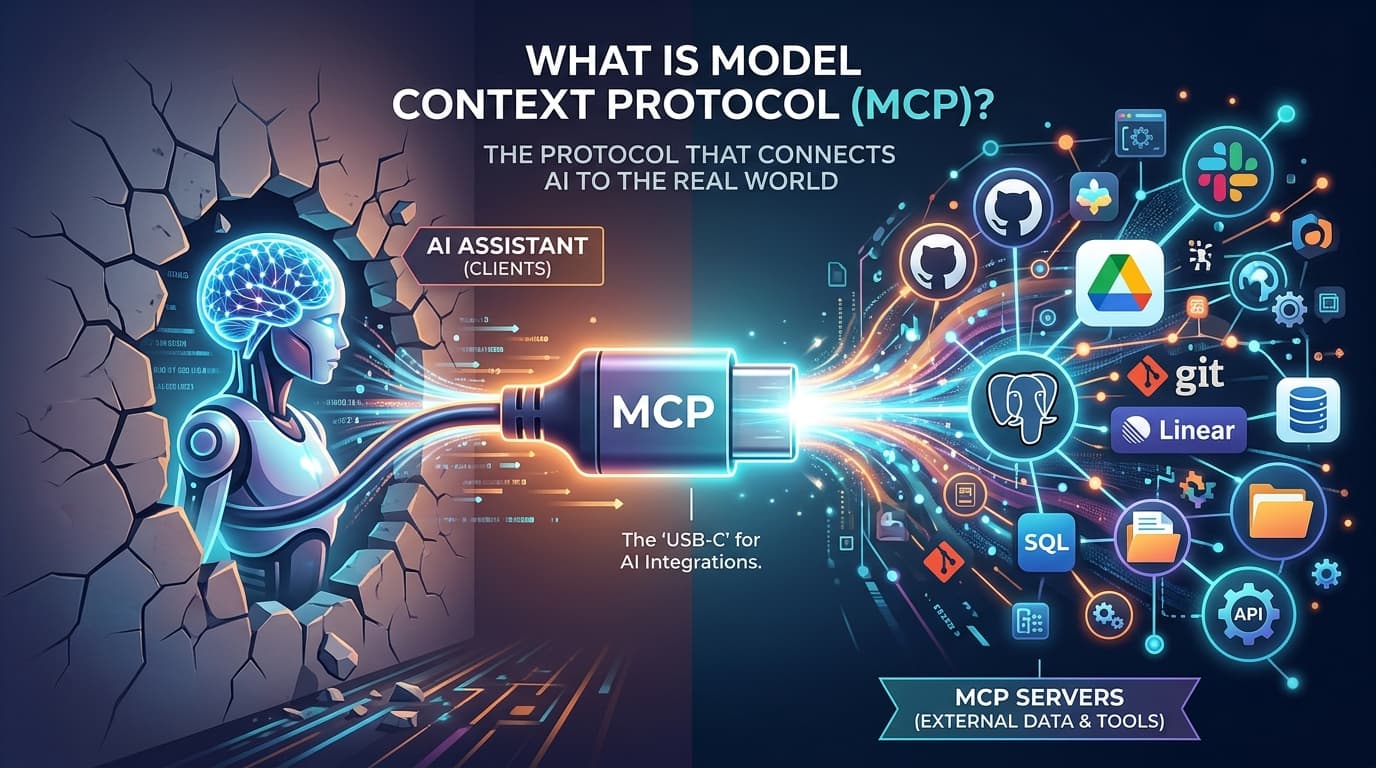
Think of it as USB-C for AI integrations. Before USB-C, every device had its own proprietary connector: Lightning for iPhones, micro-USB for Android, proprietary ports for cameras and laptops. USB-C created a universal standard so that one cable could connect any device to any charger, monitor, or peripheral.
MCP does the same thing for AI. Each data source or tool implements the MCP server protocol once. Each AI application implements the MCP client protocol once. From that point forward, any client can talk to any server — without custom glue code, without fragile one-off connectors, without starting from scratch every time.
Anthropic introduced MCP in November 2024 as an open-source standard, releasing it with SDKs for Python and TypeScript and a set of pre-built reference servers for popular systems like Google Drive, Slack, GitHub, Git, Postgres, and Puppeteer. The protocol was created by Anthropic engineers David Soria Parra and Justin Spahr-Summers — and its origin story is grounded in developer frustration: Parra had grown tired of constantly copying code between Claude Desktop and his IDE.
How MCP Works: The Architecture
MCP uses a client-server architecture with three distinct roles:
Hosts
The host is the AI-powered application that the user interacts with. This could be a chatbot, an AI coding assistant, an IDE plugin, or an enterprise workflow tool. The host is responsible for managing connections, user consent, and orchestrating the overall interaction.
Examples: Claude Desktop, Cursor, Windsurf, custom enterprise AI apps.
Clients
The MCP client lives inside the host application. It speaks the MCP protocol and maintains connections to one or more MCP servers on behalf of the host. When the AI model determines it needs to access an external resource, the client handles that request.
Servers
An MCP server is a lightweight service that exposes capabilities from a specific data source or tool. A server wraps your database, your file system, your CRM, or your API — and exposes it through a standardized MCP interface that any compliant client can interact with.
A single MCP server for Salesforce, once built, becomes accessible to every MCP-compatible AI application. The integration work is done once, not M times.
What MCP Servers Can Expose
The protocol defines three core primitives that servers can provide:
1. Tools
Tools are executable functions the AI model can call to perform actions or retrieve computed results. Examples:
run_sql_query(query: string) — execute a database query and return results
create_github_issue(repo, title, body) — open a new issue in a GitHub repository
send_slack_message(channel, text) — post a message to a Slack channel
search_documents(query) — full-text search across a file system or knowledge base
Tools represent arbitrary code execution and must be handled with care. MCP requires that hosts obtain explicit user consent before invoking any tool.
2. Resources
Resources are data objects the server exposes for the model to read. Unlike tools (which are imperative), resources are declarative — they represent content that can be loaded into context.
Examples:
The contents of a file or directory
A database record
An API response snapshot
A calendar event
3. Prompts
Prompts are pre-authored message templates or workflows that servers can provide. They allow tool authors to encode domain expertise into reusable interaction patterns that the AI can invoke.
The Communication Layer
MCP uses JSON-RPC 2.0 as its message format, transmitted over one of two transport mechanisms:
stdio (Standard I/O): For local integrations, where the host and server run on the same machine. The client spawns the server as a subprocess and communicates over stdin/stdout. This is the simplest setup and common for developer tools.
HTTP with Server-Sent Events (SSE): For remote servers and production deployments. The client connects over HTTP; the server streams responses back using SSE. This supports multi-user, cloud-hosted MCP servers that can serve an entire organization.
The protocol lifecycle follows a standard handshake:
This negotiation ensures that clients and servers can discover each other's capabilities dynamically, without hardcoded assumptions.
From Experiment to Industry Standard: The Timeline
MCP's rise from internal tool to universal standard happened with unusual speed.
Date
Milestone
November 2024
Anthropic open-sources MCP with Python and TypeScript SDKs
Early 2025
Community builds over 1,000 third-party MCP servers within months
March 2025
OpenAI officially adopts MCP across Agents SDK, Responses API, and ChatGPT desktop
April 2025
Google DeepMind confirms MCP support in Gemini models
May 2025
GitHub and Microsoft join MCP's steering committee; Windows 11 announces MCP support
November 2025
Spec updated with async operations, statelessness, server identity, and official server registry
December 2025
Anthropic donates MCP to the Agentic AI Foundation (AAIF) under the Linux Foundation
April 2026
First MCP Dev Summit North America draws ~1,200 attendees in New York City
The endorsement of competing giants — Anthropic, OpenAI, Google, and Microsoft — in a matter of months is nearly without precedent in technology standards. MCP moved from vendor-led spec to common infrastructure faster than almost any protocol in recent memory.
By mid-2025, MCP had over 97 million monthly SDK downloads and a catalog of more than 5,800 servers covering tools ranging from enterprise CRMs to local file systems to scientific databases.
Why It Spread So Fast
Several factors contributed to MCP's unusually rapid adoption:
1. Solved a real, painful problem. Every developer building with AI had already felt the M×N integration pain. MCP's value proposition required no evangelism — the itch was already there.
2. Open-source from day one. Anthropic released MCP as a fully open specification with no licensing constraints, making it immediately forkable, extensible, and trustworthy for enterprise adoption.
3. Familiar architecture. MCP was explicitly inspired by the Language Server Protocol (LSP) — a similar standardization that transformed how code editors support programming languages. Developers who understood LSP immediately grasped MCP's design philosophy.
4. Reference implementations lowered the bar. Pre-built servers for Google Drive, GitHub, Slack, and Postgres meant developers could see MCP working within minutes, not weeks.
5. Vendor-neutral governance. Donating MCP to the Linux Foundation's Agentic AI Foundation removed concerns about a single vendor controlling a critical infrastructure standard. It now sits alongside Kubernetes, PyTorch, and Node.js as community-governed open infrastructure.
MCP in Practice: A Real Workflow
To make this concrete, here's how MCP might power an AI assistant for a software engineering team:
User: "Summarize the open bug reports from last week and
       create a prioritized task list in Linear."

AI Host (Claude)
    │
    ├──► [MCP Client] ──► GitHub MCP Server
    │                      • tools/call: search_issues
    │                        (state: open, created: last 7 days)
    │                      ← returns: 23 issues with metadata
    │
    ├──► [MCP Client] ──► Linear MCP Server
    │                      • tools/call: create_issue × N
    │                        (title, priority, description)
    │                      ← returns: issue URLs
    │
    └──► Synthesized response to user with summary + links
The AI model never directly touches GitHub or Linear APIs. It reasons about what needs to happen, the MCP client handles the mechanics, and the servers enforce authentication, rate limits, and permissions — each in their own domain.
Security Considerations
With the power to execute code and access live data comes real security responsibility. MCP's April 2025 security audit surfaced two classes of concern that the community continues to address:
Prompt injection via tool descriptions: A malicious MCP server could embed instructions in its tool descriptions designed to manipulate the AI model's behavior — redirecting it to exfiltrate data through other connected tools, for example.
Tool spoofing: Lookalike tool names (e.g., a fake github_create_issue that silently exfiltrates the body to an external endpoint) can be introduced if server provenance isn't carefully controlled.
MCP's response has been to push these responsibilities to the protocol layer and implementors:
Hosts must obtain explicit user consent before invoking tools
Tool descriptions from untrusted servers should be treated as untrusted input by hosts
The November 2025 spec update introduced server identity primitives to help verify provenance
An official server registry enables curated, vetted discovery as an alternative to arbitrary server URLs
This isn't a reason to avoid MCP — it's a reason to implement it deliberately.
MCP vs. Other Approaches
Approach
Mechanism
Portability
Standardized?
Custom connectors
Bespoke per integration
None
No
OpenAI function calling
Vendor-specific schema
OpenAI only
Partial
ChatGPT Plugins
HTTP + OpenAPI schema
ChatGPT only
Partial
LangChain tools
Python framework
Framework-only
No
MCP
Open protocol + SDKs
Any compliant client/server
Yes
The key differentiator is portability. An MCP server built for one AI application works with every compliant AI application. An OpenAI function definition works only with OpenAI's API.
The Road Ahead
MCP's roadmap — now shaped by the broader AAIF community rather than Anthropic alone — points toward several frontiers:
Multimodal context: Current MCP is primarily text and structured data. Extensions for streaming audio, video feeds, and sensor data are in active discussion.
Stateful sessions: The base protocol is stateless. Research into extensions like CA-MCP (Context-Aware MCP) explores giving servers shared context stores, enabling more complex multi-server coordination without routing everything through a central model.
Agent-to-agent communication: MCP may evolve to complement or merge with Agent-to-Agent (A2A) protocols, enabling AI agents to invoke other AI agents through the same standardized interface.
Richer authorization models: OAuth 2.0 integration and granular permission scoping are being formalized to give enterprises fine-grained control over what AI systems can access.
Why This Matters Beyond the Technical Details
There's a larger pattern here worth naming.
The internet didn't become the internet because browsers got smarter. It became the internet because TCP/IP, HTTP, and HTML created a shared substrate on which anyone could build, interoperate, and innovate — without asking permission from any central authority.
MCP is attempting something analogous for AI agents. Not just making one AI system smarter, but creating the infrastructure layer that allows AI systems to participate in the broader digital ecosystem as first-class agents — reading, writing, querying, creating, and coordinating through standardized interfaces.
If that vision fully materializes, MCP won't just be a developer convenience. It will be the protocol that connected AI to the world.